 Send mail:
 Call us:+86-510-87555500
 Whatsapp:+86 18006174555
 Search
 English
  中文简体
中文简体 日本語
日本語 русский
 عربى
عربى Inquiry Us Now
Portable Steel Bridges for Flood Recovery: Design, Deployment and Sourcing
When floodwater finally drops, the damage it leaves behind is rarely only about buildings. Roads wash out, embankments slump, and the small crossings that link villages, farms, industrial parks and distribution depots to the outside world are often among the first things to fail — and the last to come back. For anyone coordinating recovery work, that gap between the water going down and traffic moving again is the real emergency.
A portable steel bridge is designed for exactly that moment. It is a prefabricated, modular structure that can be trucked to a damaged crossing, assembled with bolted or pinned connections and modest lifting equipment, and opened to traffic in days rather than months. Over sixteen years of fabricating and installing steel structures, we have seen how much difference the right specification makes. This guide sets out what to consider so your flood-recovery crossing holds up, not only this season but the next one too.
Content
- 1 What Makes a Steel Bridge Truly Portable?
- 2 Why Steel Is the Right Material After a Flood
- 3 Matching the Bridge to the Job: Span, Load and Waterway
- 4 Foundations and Abutments: The Part That Decides the Schedule
- 5 Crossing the Water: A Typical Deployment Sequence
- 6 Designing for the Next Flood, Not Only This One
- 7 How Long Does It Really Take?
- 8 What We Have Built in Similar Conditions
- 9 Choosing a Fabricator: Questions Worth Asking
- 10 A Crossing That Comes Back
What Makes a Steel Bridge Truly Portable?
Portability is not a marketing word here; it describes a set of deliberate engineering decisions. The features below are what actually allow a bridge to travel on ordinary trucks and be erected without a large crane:
- Panelised main girders. Girder depth and length are built from repeating panels, so a span can be lengthened or shortened in fixed increments to suit the gap you are actually facing rather than the gap a catalogue happens to offer.
- Bolted and pinned connections. Site welding is slow, weather-dependent and hard to inspect. Pinned connections let a small crew assemble the structure with impact wrenches and torque control.
- Container-friendly packing. Components are designed to fit standard shipping containers, which matters when the road to the site is itself damaged and every kilogram of freight counts.
- Relocatable and reusable. A recovery bridge often becomes a permanent bridge later, or is recovered and stored for the next emergency. Both outcomes should be designed for from the start.
- A known load rating. Panels and pins have predictable capacities, so the finished span can be given a documented load class instead of an optimistic guess.
Why Steel Is the Right Material After a Flood
Timber is quick but short-lived in a floodplain, and concrete needs curing time and heavy lifting that a damaged site rarely allows. Steel offers a high strength-to-weight ratio, so a long span can still be light enough to launch from a temporary bank seat. It is ductile, which means it warns you before it fails rather than shattering. It is also dimensionally stable, so the parts fabricated in the shop fit the first time on site.
Just as importantly, steel can be fabricated in a factory while the site is still being cleared and dewatered. That parallel work is usually the single biggest schedule saving in a flood recovery programme. With hot-dip galvanizing or a suitable coating system, a steel crossing also tolerates the wet-dry cycling and abrasive silt that follow every flood.
Matching the Bridge to the Job: Span, Load and Waterway
The most common mistake in emergency bridging is buying for the gap in front of you and forgetting the traffic that will use it. A farm access track and a trunk road detour need completely different structures. The table below shows roughly how the main categories compare.
| Bridge category | Typical clear span | Indicative live load | Typical erection window | Where it fits |
|---|---|---|---|---|
| Light utility or pedestrian | 10–30 m | Pedestrian and light vehicles up to about 8 t | 1–3 days | Village access, farm tracks, site entrances after a washout |
| Medium-duty panel bridge | 20–50 m | Single vehicles around 20–40 t | 3–10 days | County roads, utility access, temporary detours |
| Heavy-duty modular highway | 30–60 m and above | Full highway loading | 2–6 weeks | Trunk roads, permanent replacement spans, industrial estates |
Longer spans are achievable in multi-storey or multi-panel configurations, but they demand proper engineering rather than improvisation. Steel box girders and plate girders fabricated off site and delivered as complete units are a common choice where a permanent highway crossing has to be restored, because they combine a shallow construction depth with high torsional stiffness — useful when the road profile must be kept low.
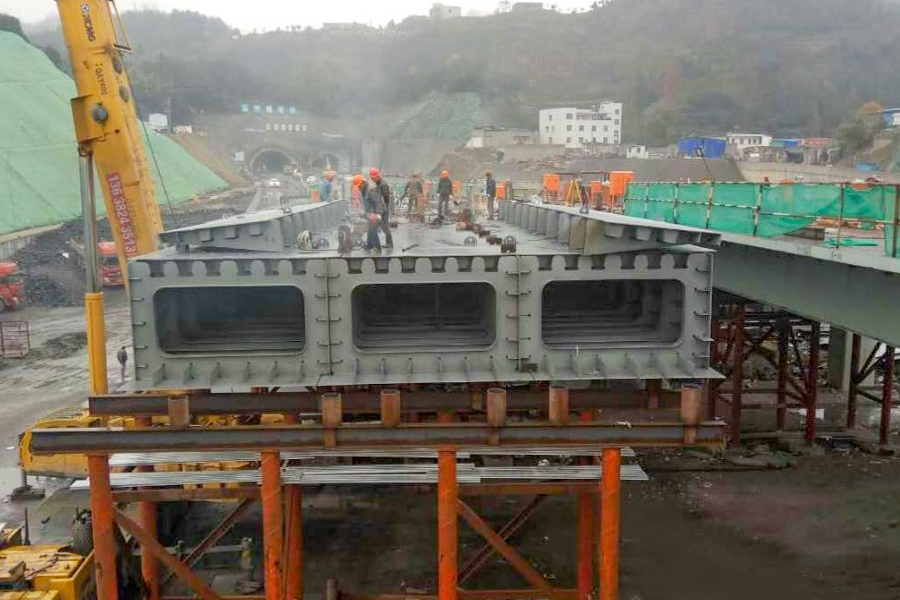 8th Span Steel Box Girder, Fengxin Express Line, ZunyiCompleted in 2017, this single-box three-cell steel box girder has a 2.2 m depth and 16 m deck, showing shallow-depth highway bridge practice.View Product →
Foundations and Abutments: The Part That Decides the Schedule
Everyone focuses on the span, but the abutments are where flood recovery projects are won or lost. Floodwater scours the soil behind and beneath a bridge, so the ground you intend to bear on may no longer be there. Before anything is ordered, the site needs a geotechnical view and, ideally, a check on how deep the scour has gone at each bank.
Where speed matters more than permanence, a temporary bank seat on gabion baskets, mass concrete blocks or driven steel piles can support a portable span within days, with the permanent abutment built later and the bridge lifted onto it. Where the crossing must be permanent from the outset, reinforced concrete abutments on piles remain the dependable answer. Either way, the bearings, expansion allowance and drainage details should be settled at the same time as the span design, because they carry the loads everyone forgets about.
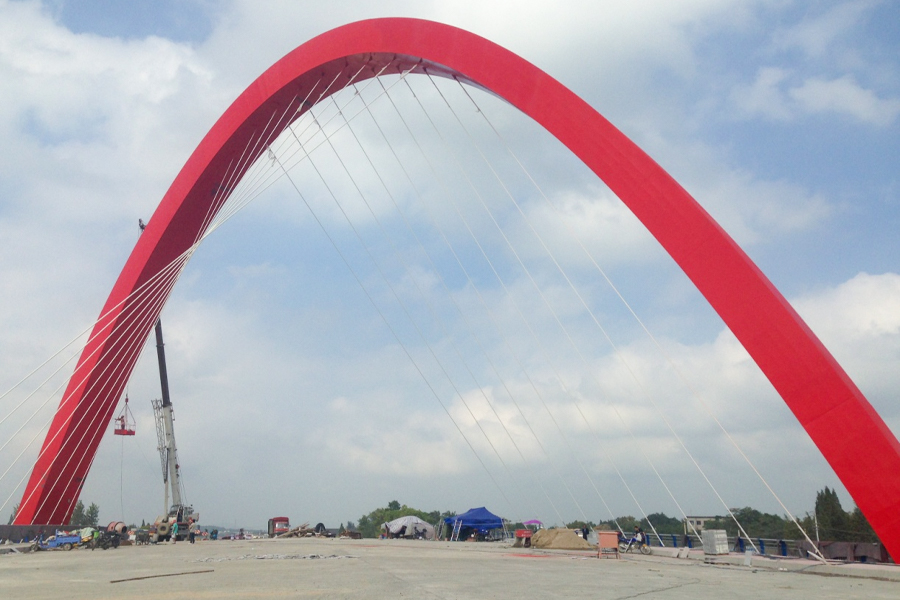 Approach Bridge Crossing Canal, Bangladesh Power Plant EPC ProjectSingle-span 42 m canal crossing with a 28 m arch-like form, built in 2014 under a Bangladesh power plant EPC project.View Product →
Crossing the Water: A Typical Deployment Sequence
In practice, a flood recovery bridge follows a fairly predictable path. Keeping these steps in order is what stops an emergency turning into a second disaster:
- Survey the site, the waterway and the scour damage, and record the temporary bank levels.
- Agree the load case, the clear span and the required freeboard with the authority that will open the crossing.
- Fabricate and trial-assemble the steelwork in the shop, including connection fit-up.
- Prepare the abutments, approaches and a compacted working platform for the erection crew.
- Deliver components in sequence so that nothing is double-handled on a congested site.
- Launch the span by crane, by cantilever pushing or by rolling forward on the bank seats.
- Install the deck, parapets, edge protection and any drainage or lighting required.
- Load test, document the as-built load rating, and hand over with an inspection plan.
Designing for the Next Flood, Not Only This One
A recovery bridge should be designed for the flood that has just happened and for the one after that. Three points come up again and again in our project reviews.
Hydraulic capacity. Set the soffit high enough for the design flood plus a sensible allowance for debris. Water that is forced under a low soffit accelerates, scours harder and puts dynamic loads on the structure that no one budgeted for.
Scour protection. Riprap, gabion mattresses and stone pitching at the abutments are inexpensive compared with replacing a bridge. They should be part of the original scope, not an afterthought.
Corrosion protection. Hot-dip galvanizing is the default for modular components, with a coating system or weathering steel where appearance and long-term maintenance costs matter. Detailing matters too: water must be able to drain off, and connections should be sealed against silt-laden water.
How Long Does It Really Take?
For a stocked modular system with usable abutments already in place, three to ten days from delivery to first vehicle is a realistic target. Where the abutments must be built or rebuilt, add two to six weeks for foundations and approach works, which is usually the controlling item rather than the steel itself.
A fully engineered permanent replacement span typically runs from a few weeks to a few months, depending on survey, design approval, fabrication slots and site access. The practical advice is to start the survey and the load-case discussion on day one, even while the floodwater is still high. Those two decisions unlock everything else.
What We Have Built in Similar Conditions
Our own work sits at the heavier end of this spectrum. We fabricate steel box girders, plate girders and cross-canal approach bridges, and we have delivered structures in highway and power-plant programmes both in China and overseas, including river crossings in Shanghai and canal crossings abroad. That experience shapes how we detail a bridge: connections that assemble without site welding, members sized for ordinary road transport, and corrosion protection chosen for a life in a floodplain rather than a showroom. If you would like the longer version, you can read more about our background and manufacturing capability on our about page.
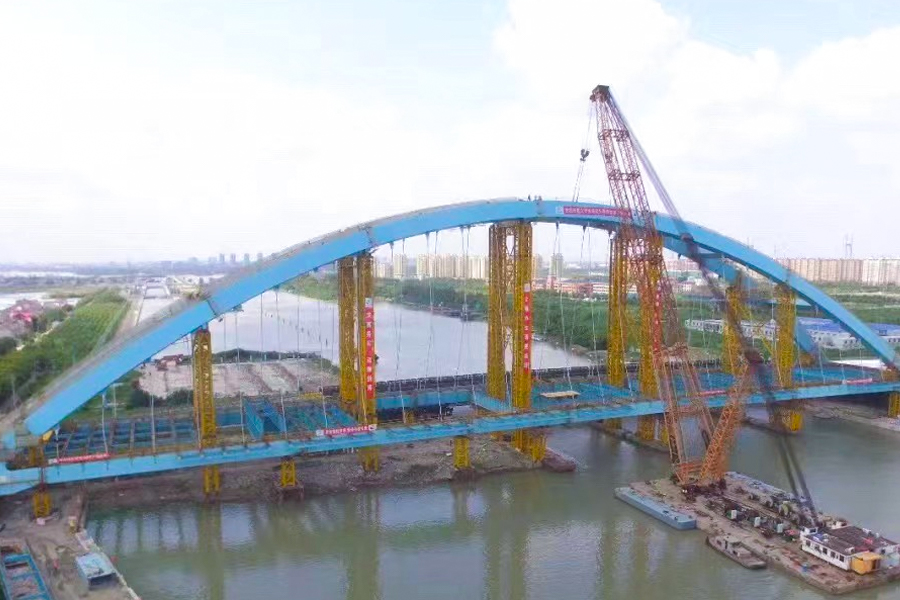 Puxing Highway Bridge Basket-Handle Tied Steel Arch, Shanghai230 m main span tied steel arch in Shanghai, with inclined ribs, 27 hangers, and landmark scale as a project reference.View Product →
Choosing a Fabricator: Questions Worth Asking
Whoever supplies your crossing should be able to answer these without hesitation. If they cannot, keep looking.
- Can you show a bridge you have built over a comparable waterway, with spans and loads stated?
- Who carries out the connection design, shop drawings and trial assembly?
- How is each component protected against corrosion, and what is the expected maintenance cycle?
- Can the bridge be dismantled, stored and reused, and does the design allow for it?
- What are your responsibilities on delivery, erection, load testing and handover documentation?
It also helps to understand where the responsibilities sit across the whole supply chain. This overview of steel structure design, sales and installation covers the buyer's side of that conversation in more detail.
A Crossing That Comes Back
Flood recovery is not the moment for heroics; it is the moment for a bridge that arrives in containers, goes together with bolts, and opens to traffic before the next rainfall. Choose a modular steel system, respect the waterway, spend the money on the abutments, and protect the steel properly. Do those four things and the crossing you build this month will still be carrying traffic long after the flood has been forgotten.
Interested in cooperation or have questions?
Contact Us Now !


 +86 18006174555
 +86-510-87555500
No. 8 Wushuang Road, Zhangzhu Town, Yixing City, Jiangsu Province, China
QR Code

Copyright © 2025 by Wuxi Rongbro Intelligent Equipments Co., Ltd. Rights Reserved.
 Steel Structure EPC Contractor