 Send mail:
 Call us:+86-510-87555500
 Whatsapp:+86 18006174555
 Search
 English
  中文简体
中文简体 日本語
日本語 русский
 عربى
عربى Inquiry Us Now
Modular Truss Bridge for Highway Construction: Design, Erection & Delivery
Highway construction is a race against the calendar. Every week a detour, a haul route or a river crossing stays out of service, the project loses money and road users pay for it. A modular truss bridge for highway construction answers that pressure with a simple idea: manufacture the structure from standard steel panels, deliver it on ordinary trucks, bolt it together in days, and open it to full highway loading.
We are Wuxi Rongbro Intelligent Equipments Co., Ltd., a steel fabrication and installation company based in Wuxi, China. Since 2009 we have designed, manufactured and installed high-precision prefabricated steel components for industrial plants, public buildings, port and petrochemical equipment, and transport structures including highway bridges. This guide collects the practical points our engineers raise whenever a client asks about a modular truss bridge for a highway project.
Content
- 1 What Makes a Truss Bridge Modular?
- 2 Where Modular Truss Bridges Fit in Highway Construction
- 3 Design and Engineering Considerations for Highway Loads
- 4 Fabrication, Detailing and Quality Control
- 5 Erection on Live Highway Projects
- 6 Reuse, Relocation and Whole-Life Value
- 7 Choosing a Fabrication and Installation Partner
- 8 Key Takeaways for Your Next Highway Crossing
What Makes a Truss Bridge Modular?
A modular truss bridge is a prefabricated steel truss built from repeating panels. Rather than being welded together on site, it is assembled from factory-made units that share the same connection geometry, so a panel can be added, removed or replaced without redesigning the whole structure. Panel lengths of about 3 m are the industry norm, and span is extended simply by adding bays.
A typical kit contains:
- Standard truss panels with top and bottom chords, verticals and diagonals, joined by high-strength friction grip bolts;
- Floor beams and stringers sized to the required carriageway width and traffic loading;
- Deck units — steel plate, precast concrete, timber or open grating — installed after the truss is standing;
- Bearings, expansion joints, kerbs, parapets and approach slabs;
- Galvanized or weathering steel finishes, plus the bolts, packers and spares needed for maintenance.
Single spans from roughly 12 m to 60 m are routine, while multi-span configurations regularly exceed 100 m where piers are economical. Through truss, pony truss and deck truss layouts are all available, so vertical clearance and approach geometry rarely force a bespoke redesign.
Where Modular Truss Bridges Fit in Highway Construction
In a highway programme, modular truss structures appear in five recurring situations:
- Temporary detour bridges that carry live traffic around a main bridge or interchange under construction, then come down and move to the next site;
- Construction access and haul bridges across rivers, canals and ravines, sized for concrete mixers, piling rigs and cranes rather than for finished highway loading;
- Permanent short-span crossings on rural roads, secondary routes and ramps, where speed of construction matters more than architectural finish;
- Staged widening works, keeping one carriageway open while the other is rebuilt;
- Emergency replacement after floods, scour or vehicle damage, when a crossing is needed in weeks rather than seasons.
Because the same panels can serve as a temporary detour, then be dismantled and re-erected as a permanent bridge elsewhere, modular systems often deliver the lowest whole-life cost of any short-span option — particularly when a project has several crossings to solve.
The fabrication discipline behind that performance is the same discipline we apply to heavier highway steelwork. On Section 3 of the Fengxin Expressway, our scope covered the eighth-span steel box girder, which demanded the same precision detailing, welding control and heavy-lift logistics that a modular truss programme requires.
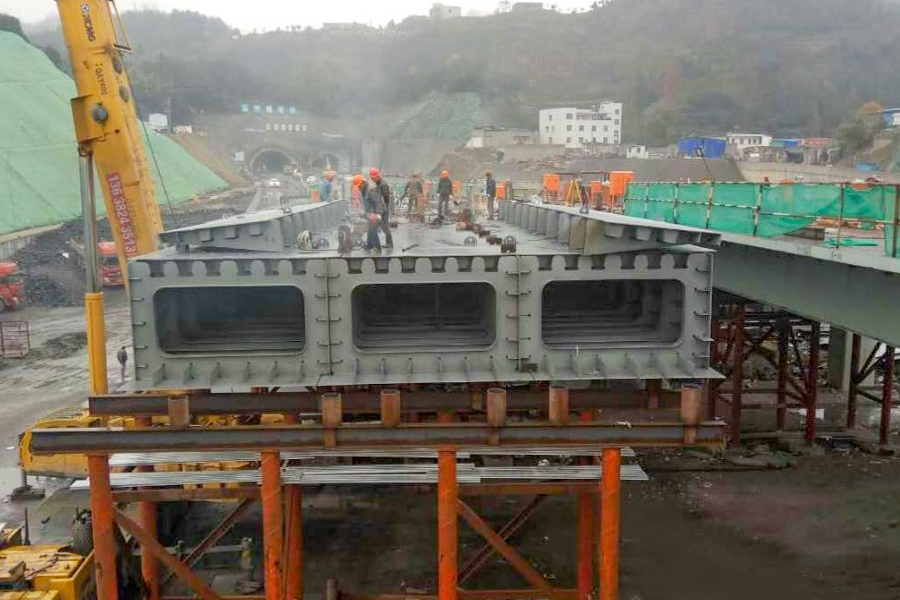 8th Span Steel Box Girder of Section 3, Fengxin Express Line, Zunyi City, Guizhou ProvinceIn 2017, the 8th span steel box girder of Section 3 of the Fengxin Express Line in Zunyi City, Guizhou Province, was completed. The project was designed and EPC-contra...View Product →
Design and Engineering Considerations for Highway Loads
Span, Geometry and Load Rating
Everything starts with the governing load model — AASHTO LRFD HL-93, Eurocode LM1 or the local highway code — and the heaviest vehicle the bridge will ever see, which for a haul bridge is often a tracked crane rather than a truck. Truss depth is usually set between one-eighth and one-tenth of the span for an efficient structure, and live-load deflection limits, commonly L/800 for highway bridges, should be checked early, because they frequently govern depth rather than stress. Skew, longitudinal grade, vertical clearance and fatigue from repeated truck cycles all need confirmation before fabrication begins.
Deck Options and Wearing Surfaces
The deck decides both the dead load on the truss and the maintenance profile over the next twenty years.
| Deck option | Erection speed | Best suited to | Maintenance profile |
|---|---|---|---|
| Steel plate deck with asphalt | Fast | Permanent crossings with low dead-load limits | Periodic resurfacing; inspect galvanized underside |
| Precast concrete units | Moderate | Permanent crossings with heavy traffic volumes | Long wearing-course life, heavier lifts |
| Timber or glulam deck | Fast | Temporary detours and remote haul routes | Re-decking every ten to twenty years |
| Open steel grating | Fastest | Construction access and industrial haul roads | No wearing course; monitor slip resistance |
Corrosion Protection, Fatigue and Service Life
Highway bridges live with de-icing salt, spray and abrasive traffic. Hot-dip galvanizing applied after all welding and drilling is the default protection for modular panels, and bolt holes, vent holes and drain paths must be designed so that water is never trapped inside a closed section. Fatigue is the other long-term issue: bolted connections with properly detailed splices behave well under repeated loading, but the details must be reviewed against the relevant fatigue category, and bolt torque should be verified again after the first months of service.
Fabrication, Detailing and Quality Control
Modular bridges are only as reliable as the shop that makes them. Detailing comes first: a full 3D model, connection design, clash checks against bearings and expansion joints, and a panel numbering system that survives shipping and site handling. Our own guide to steel structure shop drawing and detailing sets out how that process protects programme and budget.
In production, the priorities are:
- Welding to qualified procedures, with dimensional checks at panel level rather than at the end of assembly;
- Trial assembly of at least one bay in the shop, so bolt holes, camber and alignment are proven before the steel leaves the factory;
- Galvanizing after fabrication, with coating thickness verified by measurement;
- Marking, packing and container loading planned by erection sequence, not by convenience.
Erection on Live Highway Projects
Most highway truss bridges go up under traffic restrictions, which makes the erection plan as important as the design. Three methods cover nearly every case: crane erection from a closed lane or hard shoulder, cantilever launching over a waterway or live carriageway, and erection on a temporary trestle with panels lifted into position. Night and weekend closures, a workable traffic management plan, and a bolted connection sequence that keeps the truss stable at every stage are all part of the package.
Once the truss is closed, the deck is installed, expansion joints and approach slabs are set, and the finished alignment is surveyed before the bridge opens. Overseas projects add shipping, customs and local supervision to the list — on the Bangladesh 337 MW / 305 MW net power plant project, our scope included an approach bridge crossing a canal, where erection sequencing and site logistics decided the schedule as much as the steel did.
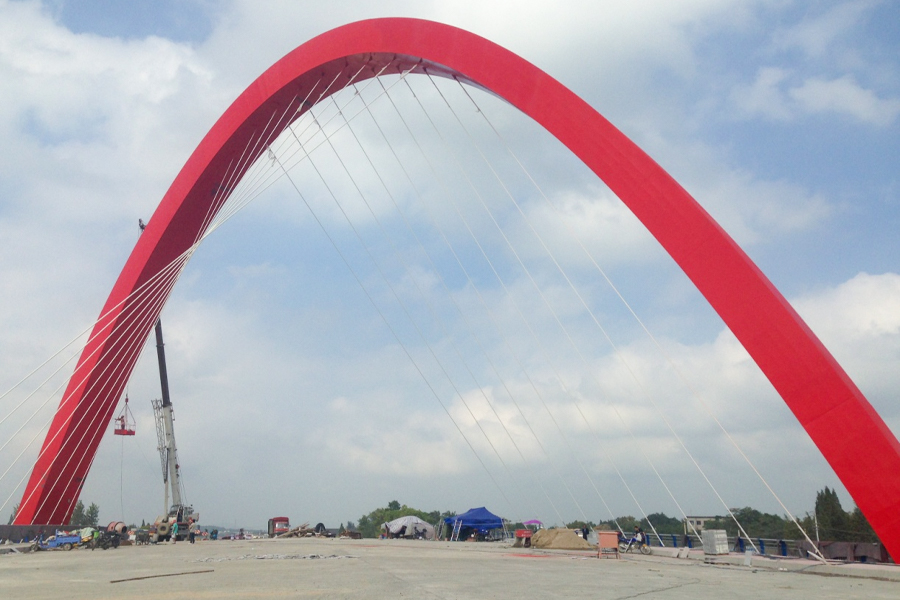 Approach Bridge Crossing Canal - Bangladesh 337MW/305MW (Net) Power Plant EPC ProjectThe approach bridge crossing the canal is part of the Bangladesh 337MW/305MW (Net) Power Plant EPC Project, which was undertaken in 2014 under the EPC contract by Chin...View Product →
Reuse, Relocation and Whole-Life Value
One advantage of a bolted modular truss is that it is an asset, not a ruin. A detour bridge can be dismantled, inspected, re-galvanized where necessary and re-erected on the next project; a permanent crossing that is later widened can have bays added instead of being replaced. Steel also retains scrap value at the end of its life, and reusing existing members avoids the carbon embedded in new concrete. For owners running several sites, that reusability can turn a one-off purchase into a fleet of crossings.
Choosing a Fabrication and Installation Partner
Modular truss bridges sit at the intersection of steel fabrication, bridge engineering and site installation, so the supplier should be able to carry all three. We have been manufacturing high-precision prefabricated steel components since 2009 and have delivered industrial plants, public buildings, port and petrochemical structures and transport projects for clients including multinational manufacturers; you can learn more about our company and how we work.
When you evaluate a partner for a highway crossing, ask for in-house detailing, galvanizing and trial assembly, references on comparable bridges, a realistic delivery schedule, and a named site crew with a method statement for erection under traffic. River crossings such as the Tashan Road bridge over the Xinlai River in Laian County, Anhui Province, show how much of the outcome depends on that combined capability.
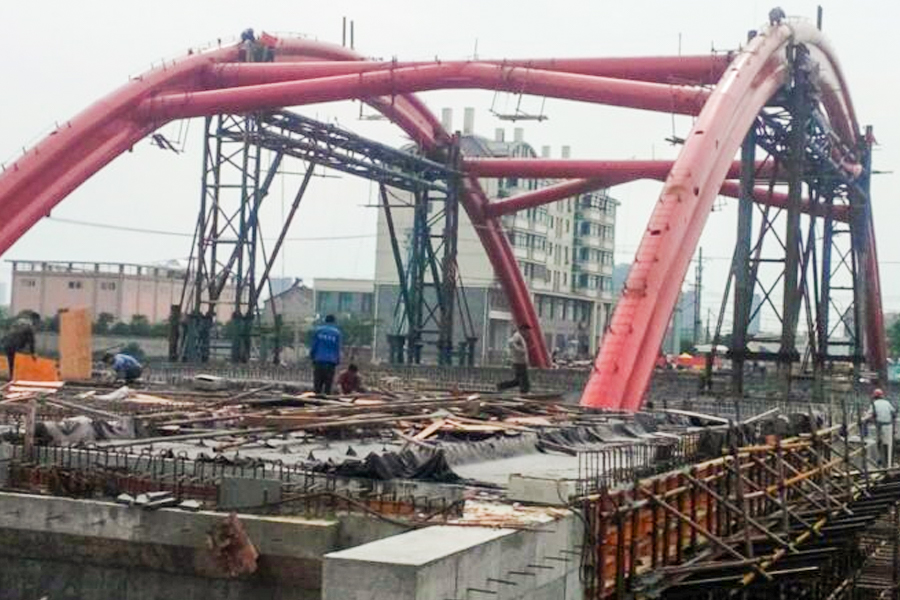 Tashan Road Bridge Crossing Xinlai River, Laian County, Anhui ProvinceThe Tashan Road Bridge crossing the Xinlai River in Laian County, Anhui Province, is a steel structure bridge project completed in 2016. The bridge adopts a double-spa...View Product →
Key Takeaways for Your Next Highway Crossing
- Confirm the governing load model and the heaviest construction vehicle before the truss is sized.
- Check deflection limits early, because they often dictate truss depth.
- Choose the deck against dead-load capacity, erection method and long-term maintenance, not just first cost.
- Galvanize after fabrication and detail every closed section so water can drain.
- Buy from a partner who details, fabricates and installs — that single point of responsibility is what keeps a highway opening on schedule.
Interested in cooperation or have questions?
Contact Us Now !


 +86 18006174555
 +86-510-87555500
No. 8 Wushuang Road, Zhangzhu Town, Yixing City, Jiangsu Province, China
QR Code

Copyright © 2025 by Wuxi Rongbro Intelligent Equipments Co., Ltd. Rights Reserved.
 Steel Structure EPC Contractor