 Send mail:
 Call us:+86-510-87555500
 Whatsapp:+86 18006174555
 Search
 English
  中文简体
中文简体 日本語
日本語 русский
 عربى
عربى Inquiry Us Now
Modular Pedestrian Bridges: Prefabricated Steel Design, Cost, and Installation Guide
When a county in Anhui needed a crossing over the Xinlai River, and a power plant project in Bangladesh had to move workers across a canal before commissioning could start, both teams settled on the same solution: a modular steel bridge with prefabricated components. That decision is not a coincidence. A modular pedestrian bridge moves the difficult work into a factory, where cutting, welding, drilling, and coating happen under controlled conditions, and then delivers finished sections to the site for bolting and lifting. The structure can be placed in days, with quality records that cast-in-place construction cannot easily match.
The conclusions that decide most bridge purchases are straightforward. Modular steel construction compresses the site program, transfers quality control into the workshop, and keeps future options open. What follows is a practical guide to specifying, fabricating, installing, and procuring modular pedestrian bridges, based on our work across industrial, public, and overseas projects.
Content
What defines a modular pedestrian bridge
A modular pedestrian bridge is a steel structure manufactured as transportable sections and assembled on site. The modules can be a single truss, a box girder split into segments, or a set of girders with a factory-installed deck system. Handrails, anti-slip deck plates, and drainage details are normally finished in the workshop, so the field team concentrates on alignment, splicing, and bearing installation.
The practical span range is roughly 10 m to 60 m in a single simply supported module, with longer crossings achieved by adding intermediate piers and multiple spans. That range covers most trail bridges, park footbridges, canal crossings, and access structures. For wider urban walkways, a multi-girder or truss configuration adds the extra deck width without increasing structural depth excessively.
Steel is the default material for modular pedestrian bridges for three reasons. It has the highest strength-to-weight ratio among common structural materials, which reduces dead load on foundations. Fabrication happens indoors, where welds can be tested and coating applied to a consistent standard. And because field connections are bolted, the bridge can be disassembled, relocated, or reused, which matters for temporary construction access and for owners planning future trail extensions.
Design information that prevents delays
The fastest way to keep a bridge project on schedule is to fix four parameters before sending an inquiry: clear span, clear width, design load, and corrosion environment. Every other decision, from member sizes to coating thickness, follows from those four. Undefined values are the main reason quotes come back with qualifications and the reason prices change after steel has already been cut.
Span, width, and what the numbers really mean
Span is the distance between the bearing centers at each abutment, not the overall bridge length. Deck drains, expansion joints, and railing end posts sit within the overall length, so confusing the two can produce a bridge that either fails to seat on its bearings or overhangs the abutment edge. Clear width is measured between the inside faces of the railings. A bridge that must carry bicycles or maintenance equipment needs more clear width than a pedestrian path, and the difference appears directly in steel tonnage and price.
| Clear width (m) | Primary use | Design considerations |
|---|---|---|
| 1.2–1.8 | Trail and maintenance access | Two pedestrians can pass; most economical |
| 2.4 | Urban sidewalk connection | Comfortable two-way pedestrian flow |
| 3.0–4.0 | Pedestrian and bicycle route | Crowd load and wind govern the design |
| 4.0+ | Emergency vehicle access | Vehicular load case required |
Loads, codes, and the maintenance vehicle question
Pedestrian bridges are controlled by crowd loads rather than heavy traffic. EN 1991-2 specifies a crowd load of 5 kN/m² for footbridges in European practice; AASHTO uses roughly 4.3 kN/m²; Chinese projects apply similar magnitudes through the JTGD series and GB 50017 steel design rules. A fabricator experienced with export work should be comfortable applying more than one code family, since the same modular system can be adapted to domestic or overseas approval requirements.
The question that changes a design the most is whether a maintenance vehicle will ever drive onto the deck. A small utility truck or mower adds a concentrated axle load that can govern the deck plate and stringer sizes. Buyers should state this need explicitly. Introducing it after fabrication may require stiffening the deck, which is expensive and delays the program.
Why fabrication quality decides field success
On a modular bridge, the shop is where structural integrity is created and the site is where it is preserved. The best on-site crew cannot correct poor welds, mismatched splice holes, or coating applied in bad weather. Buyers evaluating a fabricator should look for four specific capabilities:
- Traceable material certificates for every plate and rolled section;
- Welding procedures qualified under the applicable code and performed by certified welders;
- Dimensional control demonstrated by CNC cutting, jig-based assembly, and survey verification;
- A coating system matched to the corrosion environment and agreed in writing.
Material certificates should confirm the specified grade, such as S355 in EN terms, ASTM A709 in US terms, or Q355 in Chinese practice. Dimensional control is the most visible difference between a mature bridge workshop and a general fabrication shop. Modules are commonly produced in six- to twelve-meter segments, and flange alignment must stay within 2 to 5 mm at every bolted splice. Hole patterns that do not line up at the field joint are the single most common cause of modular bridge rework.
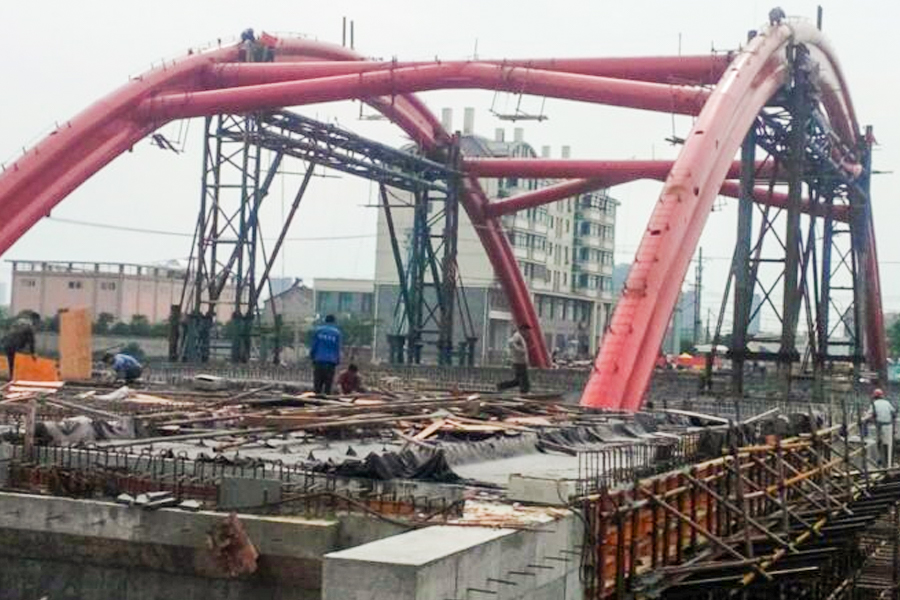 Tashan Road Bridge: Double-Span Steel Tubular Arch Over Xinlai RiverA 42-meter double-span through-type steel tubular arch bridge completed in 2016, notable as the county's first steel bridge approved by public referendum, illustrating local steel bridge adoption.View Product →
Surface protection deserves as much attention as structural design. The coating system and the surface preparation determine how many years pass before the first major maintenance operation. For an inland pedestrian bridge in a moderate environment, C3 according to ISO 12944 may be sufficient; coastal, industrial, and de-icing-salt zones usually call for C4 or C5 with a zinc-rich primer. Abrasive blasting to Sa2.5 is the normal preparation standard, and a dry film thickness agreed in advance gives both sides a clear acceptance criterion.
Our fabrication shop applies this sequence to every steel bridge contract, including the modular river and canal crossings we have delivered. A module that leaves the factory with verified geometry, complete records, and the specified coating gives the site team the best possible start.
Installation: how the schedule is compressed
The economic argument for a modular pedestrian bridge is that fabrication and site works run in parallel. While steel modules are manufactured, the general contractor completes abutments, foundations, and approach fills. When the modules arrive, installation can take days rather than months, provided lifting equipment can reach the final position. For sites without crane access, a launching beam or slide-in method moves the modules across the gap in controlled increments.
River and canal crossings
Water crossings favor modular construction because there is no way to build falsework from below. Our delivery record includes an approach bridge that carries pedestrian and light access traffic across a canal at a power plant project in Bangladesh. The steel modules were fabricated in our Wuxi workshop and shipped to the site, where the crossing was assembled without the months of formwork, shuttering, and curing that a concrete alternative would have demanded at a remote plant location.
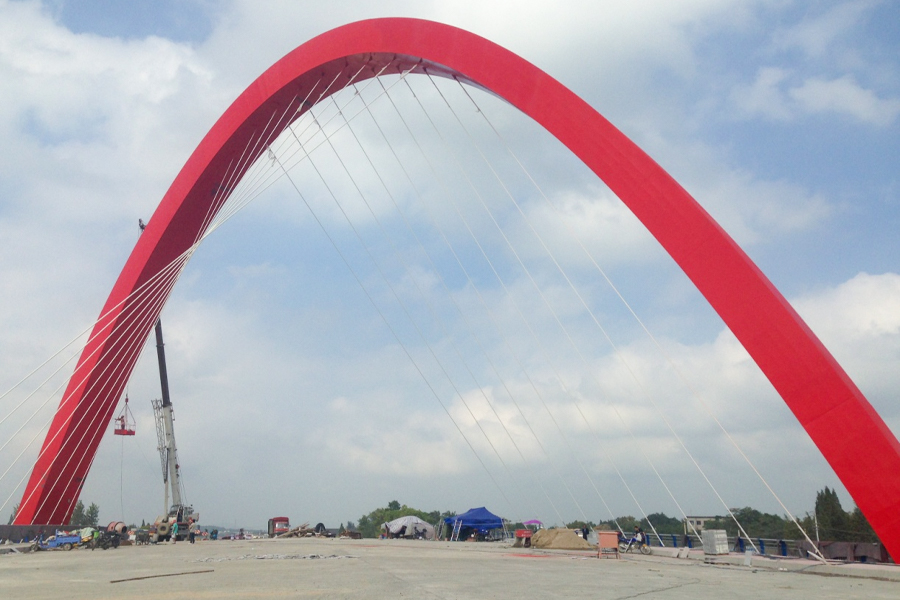 Approach Bridge for Bangladesh Power Plant: Single-Span Arch Over CanalA 42-meter single-span arch-like bridge for a 337MW/305MW EPC power project, fabricated in Wuxi and shipped to site, avoiding cast-in-place falsework at a remote location.View Product →
Crossings over live roads and expressways
When a bridge crosses a road that must stay open, modular steel is often the only economical option. A prefabricated steel box girder can be launched during a single overnight lane closure, while cast-in-place construction requires repeated traffic management setups for falsework, concreting, and formwork removal. The same logic applies to larger vehicular bridges. Our workshop has supplied prefabricated steel box girders for highway structures, positioned during planned closures and completed with bolted splices.
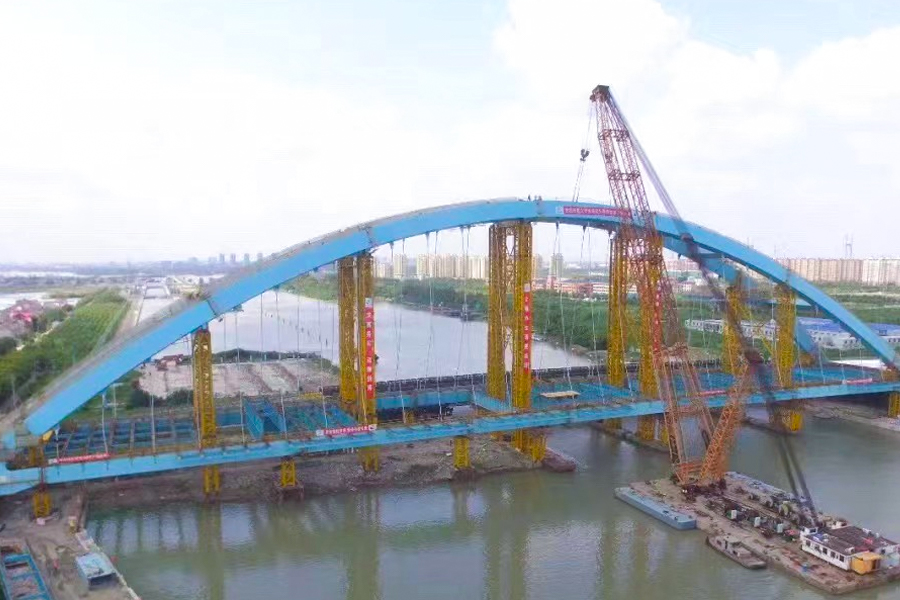 Puxing Highway Bridge: 230-Meter Basket-Handle Tied Steel ArchShanghai's largest basket-handle tied steel arch bridge, with a 230-meter main span, inclined arch ribs reaching 46 meters, and 27 hangers per side, a prominent landmark.View Product →
Successful installation depends on preparation. Lifting plan, crane position, module delivery order, bolt torque values, and bearing placement are all settled before the factory releases the first module. Field work then follows a known sequence instead of being improvised on the day, which is why modular installations so rarely miss their planned completion dates.
Procurement risks and what to verify before signing
Most problems with modular pedestrian bridges are not structural; they are procedural. The clearest risk is the interface between the bridge supplier and whoever designs and builds the abutments. Bearing elevations, anchor bolt layouts, and reaction loads must be exchanged before fabrication starts. A mismatch discovered during lifting means an expensive stop because the bridge is already on the truck.
The second risk is documentation. Buyers should require the full quality dossier at the tender stage: mill certificates, welding records, NDT reports, coating thickness measurements, and as-built drawings. When these documents are generated during production rather than assembled at the end, quality control is demonstrably real. Our company builds the dossier as work progresses and hands it over with the bridge, a practice that long-term clients have come to expect.
The third risk is logistics. Steel modules are long and heavy, and transport often controls the segment lengths. A fabricator that ships bridge steel overseas has dealt with sea freight, heavy-lift handling, and erection sequences that a purely local shop may not have considered. Buyers should ask for references that match their crossing conditions and compare total installed cost rather than workshop price alone. The division of responsibilities between design, sales, and installation is explained in our buyer guide to steel structure projects, which clarifies the handover points that prevent surprises.
Total cost and the value of a relocatable asset
A modular steel pedestrian bridge often has a higher unit price per kilogram than a conventional structure, yet the total installed cost is usually lower. Site works are smaller, the lifting event is short, and finishing trades almost disappear. Money that would have gone to site welding, scaffolding, paint touch-up, and inspection in exposed conditions is instead invested in factory work, where productivity is higher and waste is lower.
Lifecycle cost favors modular steel for the same reasons. A properly specified coating system keeps the primary structure sound for decades, and because the bridge is bolted, individual components can be replaced without demolishing the whole span. Deck plates wear, railings get damaged, and bearings need adjustment; all of these are simple jobs on a modular structure. For temporary crossings, the entire bridge can be lifted out, shipped elsewhere, and re-erected, which is why owners managing staged construction or future trail extensions prefer a system they can redeploy.
The practical lesson for a buyer is to choose a fabricator with documented experience in precision steel fabrication, a clean chain of material and welding records, and a delivery history that includes both domestic and overseas modular bridges. That combination is what we bring to a pedestrian bridge project, from the first span definition to the final site handover, and our engineering and fabrication background is documented in detail.
Interested in cooperation or have questions?
Contact Us Now !


 +86 18006174555
 +86-510-87555500
No. 8 Wushuang Road, Zhangzhu Town, Yixing City, Jiangsu Province, China
QR Code

Copyright © 2025 by Wuxi Rongbro Intelligent Equipments Co., Ltd. Rights Reserved.
 Steel Structure EPC Contractor