 Send mail:
 Call us:+86-510-87555500
 Whatsapp:+86 18006174555
 Search
 English
  中文简体
中文简体 日本語
日本語 русский
 عربى
عربى Inquiry Us Now
Bridge Truss Designs: Selecting the Right Steel Truss Configuration for Your Project
Bridge truss designs look similar at a glance, but the difference between a Warren and a Pratt is not cosmetic. A few changed diagonals change the load path, the section sizes, and the final cost of the structure. The practical conclusion is simple: choose a truss configuration only after you know the span, the live load, the available depth, and the erection method.
In steel bridge construction, a truss is a triangulated frame. The top chord is primarily in compression, the bottom chord is primarily in tension, and the web members carry shear between the two chords. Triangles are stable because their side lengths cannot change without altering the angles; that stiffness is what lets a slender steel truss carry loads that would require a much heavier solid girder.
Content
How a Truss Design Transfers Load
Every truss design is first a load path. When traffic crosses the deck, the deck transfers the load to floor beams, then to panel points on the lower or upper chord. The web members split that force into axial tension and compression. Because truss members are loaded axially rather than in bending, their steel sections can be used much more efficiently than the web of a plate girder.
The deck position changes the load path. In a deck truss, the roadway is on top and the trusses pass under the traffic. In a through truss, traffic runs between the trusses and overhead bracing connects the top chords. In a pony truss, traffic also runs between trusses, but there is no top lateral bracing. Through trusses are often chosen when vertical clearance under the bridge is limited; deck trusses are chosen when the waterway can accept a deep superstructure.
The Four Standard Truss Configurations
Four configurations appear in most steel bridge truss designs: Warren, Pratt, Howe, and K. The names describe the arrangement of the web members, not the bridge type. Since each pattern produces a different combination of tension and compression, each has a different economical range.
| Configuration | Web pattern | Load behavior | Good for |
|---|---|---|---|
| Warren | Alternating diagonals, often with verticals at panel points | Diagonals share both tension and compression | Medium spans with distributed traffic loads |
| Pratt | Diagonals slope down toward the center | Diagonals are in tension; verticals are in compression | Steel bridges with heavy concentrated loads |
| Howe | Diagonals slope up toward the center | Diagonals are in compression; verticals are in tension | Timber or hybrid decks, shorter spans |
| K | Web members subdivided into a K shape | Members are shorter, reducing buckling length | Deep trusses and seismic retrofit conditions |
The Pratt truss is the default choice for many steel bridges. Under gravity load, most Pratt diagonals are in tension, so they can be slender and efficient. The verticals are in compression, but they are short enough that buckling is not a major penalty. This makes the Pratt easy to design and economical to detail.
The Warren truss is almost as common. With only alternating diagonals, it uses fewer members, but each diagonal must handle both tension and compression. For uniform loads, the Warren is highly efficient. If concentrated loads are expected, adding vertical members at panel points keeps the diagonals short and the connections simple.
The Howe truss appears in modern work mainly in timber or hybrid bridges, because wood works better in compression and the diagonal orientation places wood in compression. In an all-steel bridge, the Howe is rarely the lightest option, but it is still useful when architectural continuity with an older structure is required.
The K truss is selected for deep trusses where unsupported web members would otherwise become too long. Subdividing the panel into a K reduces the unbraced length of the compression members and can reduce weight. The cost is more gusset plates, more welds, and more pieces to fit. It should be justified by span or seismic demands, not by habit.
Other Truss Designs You May Encounter
Outside the standard four, other truss designs are useful for rehabilitation, long-span work, or special aesthetics. Baltimore and Pennsylvania trusses add sub-dividing members to a Pratt web, which shortens panel lengths without making the truss shallower. A Parker truss is a Pratt with a curved top chord; the curved chord follows the bending moment better but adds fabrication cost. A lenticular truss has both top and bottom chords curved and meeting at the ends. It is visually striking, but the curved chord members and multiple joints make it expensive to build. Vierendeel frames are sometimes called trusses, but they have no diagonals and depend on rigid joints; they are useful when doorways or service openings are required in the web.
Span, Depth, and Connection Details
The depth of a truss has a bigger effect on stiffness than the member sizes. For a simple-span steel truss, a depth between 1/10 and 1/15 of the span is a common starting range. A 40-meter span would then need roughly 2.7 to 4.0 meters of structural depth. If that depth is not available, the truss becomes heavier and the connection forces grow sharply. In some cases a welded plate girder will be cheaper than a shallow truss, even though the girder uses more steel, because it eliminates hundreds of connections.
Connection design is where bridge truss designs succeed or fail. Gusset plates, bolts, and welds must be arranged so the centroid lines of the members meet at the working point. Eccentricities create secondary bending moments that reduce fatigue life. For highway bridges, the weld between the gusset and the chord should be checked for fatigue category, not just static strength.
Fabrication and Shop Drawing Review
The most economical truss is not always the one with the least member weight. It is the one with the fewest unique joints, the simplest fit-up, and the shortest erection sequence. That is why the shop drawing stage must be part of the design. A fabricator can catch mismatched working lines, inaccessible weld positions, or shipping dimensions that force an awkward field splice.
At Wuxi Rongbro Intelligent Equipments, we have fabricated steel structures for industrial plants, power stations, and bridge projects since 2009. Our engineering review process starts with the truss model, checks member forces against connection details, and produces drawings that the erection crew can actually use. We treat the shop drawing as the final design check, not a paperwork step.
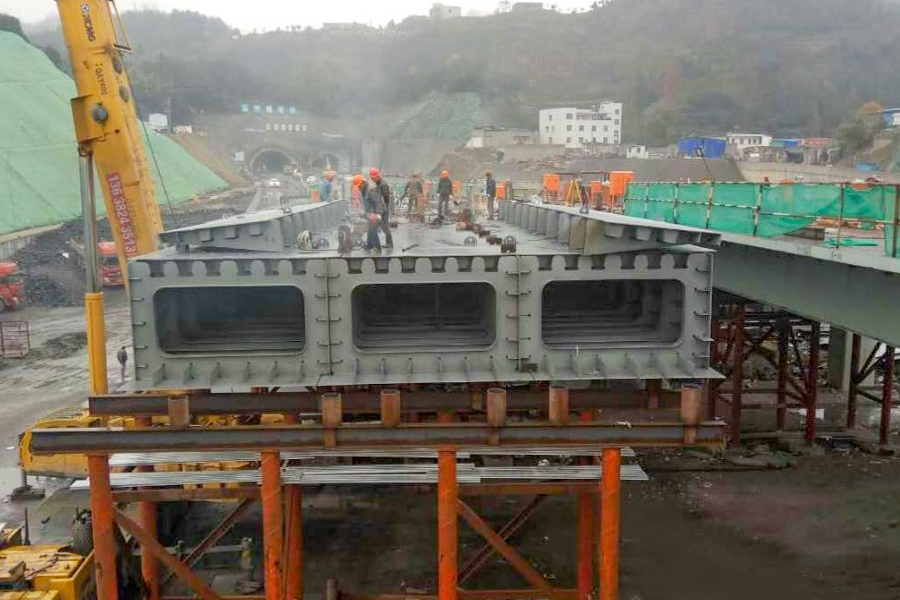 Steel Box Girder for Fengxin Express Line Section 3 in ZunyiThis 2.2-meter-deep, 16-meter-wide single-box three-cell girder totals about 2,200 tons of steel. Its wide deck and compact depth demand precise fabrication and erection control, making it a relevant benchmark for truss-related steelwork planning.View Product →
Erection Planning Determines the Final Choice
Truss bridges are erected with cranes or launched from one side. The design should include lifting points and temporary bracing positions. A lighter K-truss may be attractive on paper, but if it needs 20 percent more field connections than a Pratt, the crane time saved by lower weight can be lost in bolt installation.
For sites with limited access, the bridge is often delivered in segments and assembled on the ground, then lifted in one piece. For river crossings, falsework is expensive, so a truss that can be cantilevered or launched while it is still divided into bays may be preferred. The fabrication package must match that sequence: splice locations are based on erection, not only on truck dimensions.
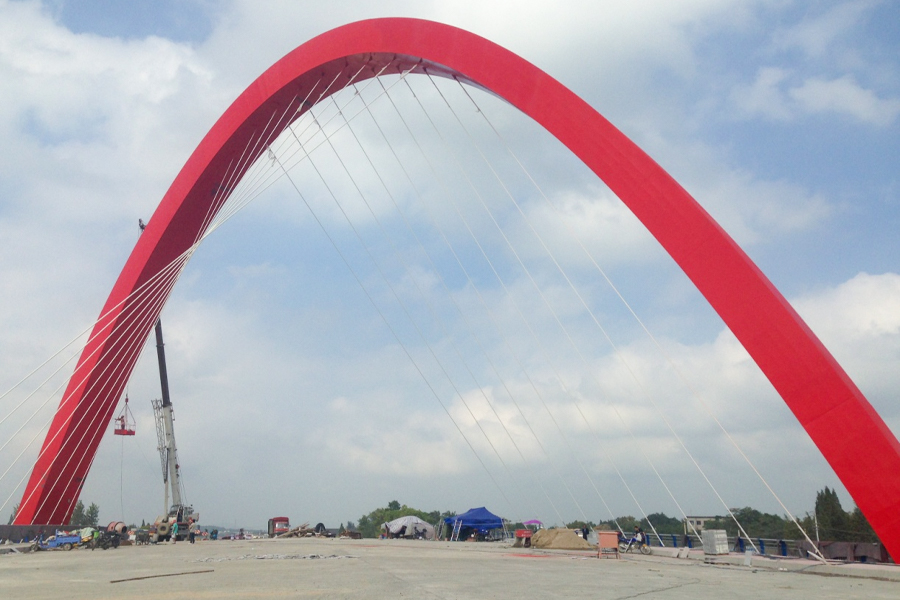 Canal Approach Bridge for Bangladesh Power Plant EPC ProjectA single-span, 42-meter approach bridge featuring a 28-meter-tall arch-like steel structure. Designed for a large power plant EPC contract, it illustrates how functional requirements can be combined with a distinctive bridge form for site-specific access.View Product →
How to Choose Among Bridge Truss Designs
The best way to choose is to test at least three configurations on the same span. Compare member weight, connection count, fatigue category, and erection cost. Price does not follow weight. A K-truss can weigh less but contain many more gusset plates. A Pratt can be slightly heavier but reduce shop labor enough to win the total bid.
Write the design brief with real constraints: live load, superstructure depth, minimum vertical clearance, number of joints, aesthetic preferences, and crane access. Share those constraints with the steel fabricator during the shop drawing review. The right configuration will feel obvious once the load path, connection details, and site sequence are all on the same table.
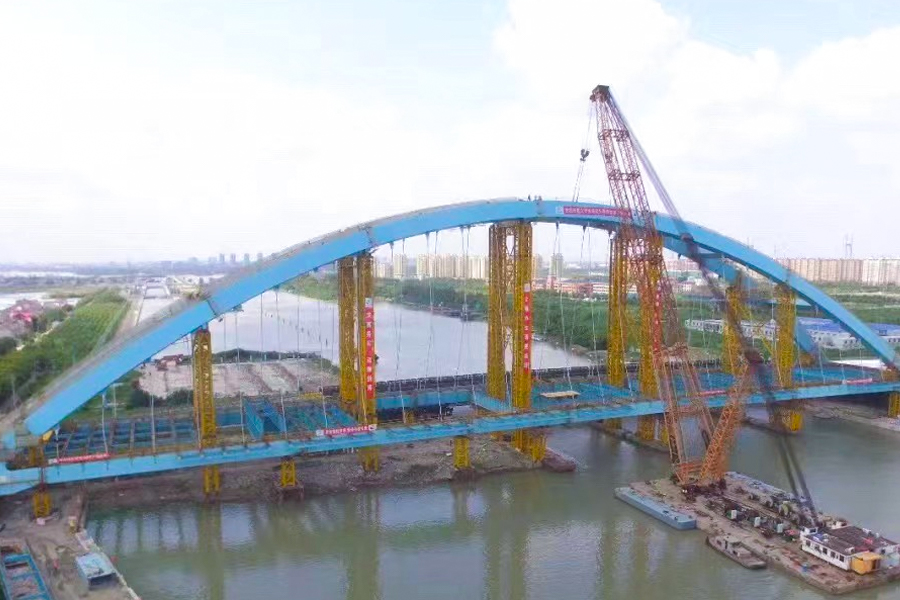 Puxing Highway Bridge Main Span Steel Tied Arch, ShanghaiThis basket-handle tied steel arch bridge has a 230-meter main span, the largest of its type in Shanghai, with inclined arch ribs and 27 hangers per rib. Its scale and landmark status make it a notable reference for large-span steel arch engineering.View Product →
Bridge truss designs should be compared by real constraints, not by pictures. A Warren truss will usually beat a Pratt for uniform loads, but the Pratt will often win when live loads dominate. The Howe belongs mostly to timber history, and the K should be reserved for deep spans or seismic demands. Once you fix the span, depth, connection type, and erection method, the economical truss design becomes a straightforward engineering decision. For a project-specific review, contact our steel structure team with the site dimensions and load case.
Interested in cooperation or have questions?

Contact Us Now !


 +86 18006174555
 +86-510-87555500
No. 8 Wushuang Road, Zhangzhu Town, Yixing City, Jiangsu Province, China
QR Code

Copyright © 2025 by Wuxi Rongbro Intelligent Equipments Co., Ltd. Rights Reserved.
 Steel Structure EPC Contractor