 Send mail:
 Call us:+86-510-87555500
 Whatsapp:+86 18006174555
 Search
 English
 中文简体
 日本語
 русский
 عربى
 Inquiry Us Now

Steel Truss Bridge Guide: Forms, Design, Fabrication and Erection Tips
A steel truss bridge does one thing extremely well: it turns a long span into a series of short, manageable members. Instead of one deep beam carrying everything, the load travels through a triangulated frame, so each chord, diagonal and vertical does a clearly defined job. That logic has survived for well over a century because it works, and because it suits the way steel is actually made, shipped and assembled.
We have spent years fabricating and installing steel structures of many kinds, and bridge work has a rhythm of its own. The following is a plain-language walk through how truss bridges behave, which forms suit which crossings, and what tends to matter once a drawing becomes a truckload of painted steel.
Content
- 1 How a Steel Truss Bridge Carries Load
- 2 The Main Truss Types and What They Suit
- 3 Why Steel Is Still the Natural Choice
- 4 Details That Decide How a Truss Bridge Performs
- 5 Fabrication, Trial Assembly and Erection
- 6 Where Truss Bridges Still Make Sense
- 7 Cost, Inspection and Maintenance
- 8 Briefing a Fabricator Well
How a Steel Truss Bridge Carries Load
A truss is a framework of straight members connected at joints, arranged so that the whole assembly acts as a unit. Loads applied to the deck pass into the floor beams, then into the truss nodes, and finally down to the bearings and abutments. Because the geometry is triangulated, individual members experience mainly axial force, either tension or compression, rather than bending. That is the efficiency at the heart of the form.
Two details shape almost every early design decision. The first is whether the deck sits on top of the trusses (a deck truss) or passes between them (a through truss, with overhead bracing) or between shallow trusses without overhead bracing (a pony truss). The second is where the connections sit and how they are made, since gusset plates and splices are where analysis meets fabrication reality.
The Main Truss Types and What They Suit
Most truss bridges you will see are variations on a handful of patterns. The differences are not cosmetic: they change which members are in tension, how long individual pieces become, and how easy the structure is to fabricate and erect.
| Truss pattern | Typical feel | Where it works well |
|---|---|---|
| Pratt | Medium spans | Diagonals slope toward midspan and work in tension, with shorter compression members; a dependable choice for road and rail crossings. |
| Howe | Medium spans | Diagonals slope away from midspan and work in compression; historically favoured where tension connections were the weak point. |
| Warren | Short to medium | Alternating equilateral triangles with no verticals; simple, repetitive fabrication and a clean look for pedestrian and utility crossings. |
| Parker and camelback | Longer spans | Pratt-style webs under a polygonal top chord, which follows the bending moment and trims material from the panels near midspan. |
| K-truss | Deep, heavy trusses | K-shaped web patterns shorten member lengths and suit tall trusses where transport and buckling lengths become the constraint. |
| Modular or panelised | Short spans, temporary works | Reusable bolted panels for detours, construction access and emergency replacement where speed matters more than refinement. |
Why Steel Is Still the Natural Choice
Steel offers a high strength-to-weight ratio, which means a truss can span further with lighter members and smaller foundations than many alternatives. Just as importantly, it is a factory material. Members are cut, drilled, welded and painted under cover, where tolerances can be held to a millimetre and inspection happens before anything leaves the yard.
That prefabrication changes the site programme. Instead of weeks of formwork and curing over a river or a live road, you get deliveries, a crane, bolted splices and a closure pour. Fewer site hours usually means less disruption, less weather risk and a safer working area. Steel is also ductile, so it absorbs dynamic and seismic demands well, and it can be recycled or reused when a crossing is widened or replaced.
Details That Decide How a Truss Bridge Performs
Two bridges with identical truss geometry can behave very differently in service, and the difference is nearly always in the details.
- Connections: bolted field splices speed erection and give predictable slip behaviour; welded shop connections reduce plate clutter but demand controlled procedures and inspection.
- Fatigue: repeated truck or rail loading makes detail category matter. Smooth transitions, avoiding overlapping welds and keeping out-of-plane movement in check all extend life.
- Corrosion protection: coating systems, galvanising or weathering steel each suit different environments. What matters is specifying one system and inspecting it consistently.
- Drainage and access: water sitting in a chord or a gusset is a slow, expensive problem. Weep holes, sealed joints and safe inspection access are cheap at design stage.
- Bearings, expansion and camber: a truss moves. Camber built into the shop, correct bearing settings and proper expansion joints prevent locked-in forces and deck cracking.
None of these are exotic. They are simply easier to solve on paper than on a scaffold.
Fabrication, Trial Assembly and Erection
Good bridge fabrication starts with shop drawings that reflect how the structure will actually be built, not just how it was analysed. Member marks, splice locations, lifting points and erection sequence all belong in that conversation. On truss work we favour a trial assembly of critical panels in the yard, because a hole that does not line up in the shop is a hole that will not line up over water.
Transport sets practical limits on member length and weight, so panel points are often chosen with truck and crane capacity in mind as much as structural efficiency. On site, most trusses go up by crane in pre-assembled units, with temporary supports until the closure panel is bolted and the deck is continuous. Where access is tight or the crossing must stay open, launching or sliding methods can move a complete span into place with minimal falsework.
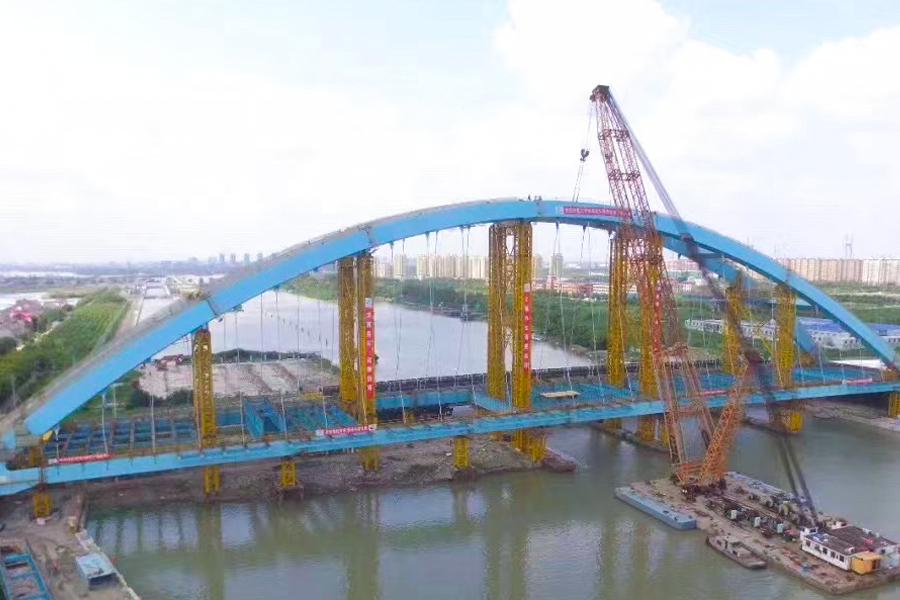 Puxing Highway Bridge Steel Arch Case StudyCase study of a 230 m basket-handle tied steel arch bridge in Shanghai, illustrating large-span steel bridge engineering and landmark structural scale.View Product →
Where Truss Bridges Still Make Sense
Trusses are not a heritage curiosity. They remain a strong answer for pedestrian and cycle crossings, utility and pipeline bridges, short-span road bridges on local networks, and rail structures where stiffness and shallow construction depth matter. Modular panelised trusses are ideal for detours and construction access, since they can be dismantled and reused elsewhere.
They also travel well. Because members nest and splice, a truss can be shipped in containers and assembled with modest lifting equipment, which is why prefabricated steel spans remain popular on overseas infrastructure and power projects where site resources are limited.
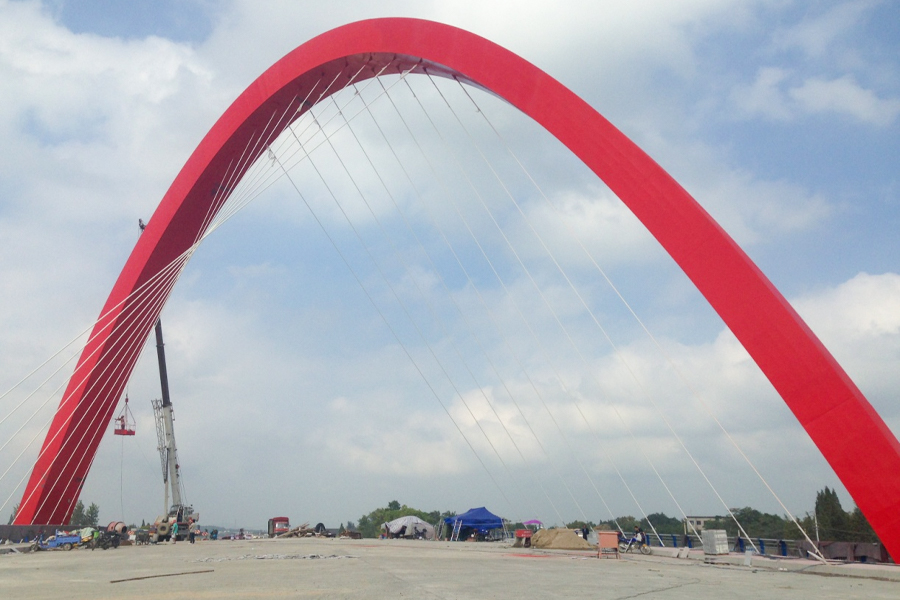 Bangladesh Power Plant Canal Approach BridgeCase study of a 42 m single-span, 28 m-high canal crossing for a Bangladesh power plant, combining functional design with a distinctive arch-like form.View Product →
Cost, Inspection and Maintenance
The cheapest bridge to build is rarely the cheapest to own. A truss has many members and many connections, so inspection effort is higher than for a simple girder, and coating maintenance is a recurring cost. That is not an argument against trusses; it is an argument for designing inspection access in from the start and for choosing a protection system you can realistically maintain.
Weathering steel can remove painting from the cycle in suitable environments, but it needs detailing that avoids traps and staining. Bolted connections need a check after the first years of service, and bearings and expansion joints deserve a scheduled look rather than a reaction to noise. A short maintenance plan agreed at handover saves a great deal of guessing later.
Briefing a Fabricator Well
If you are preparing a truss bridge enquiry, a handful of inputs will get you a far more useful response: the span and clearance envelope, deck width and load class, alignment and skew, site access and crane reach, the governing design code, and the date the crossing must open. Concept drawings, geotechnical constraints and any environmental limits help too. With those in hand, a fabricator can talk sensibly about member sizes, splice positions, coating and erection method rather than guessing.
We have been making high-precision prefabricated steel components since 2009, and bridge work sits alongside our industrial, public building and equipment structures. If it would help to see how we approach a crossing, our transportation engineering and steel bridge work shows box girders, approach spans and river crossings we have delivered, and you can read more about our background and capabilities. When you have a span in mind, send the basic parameters and we will tell you honestly what we would build.
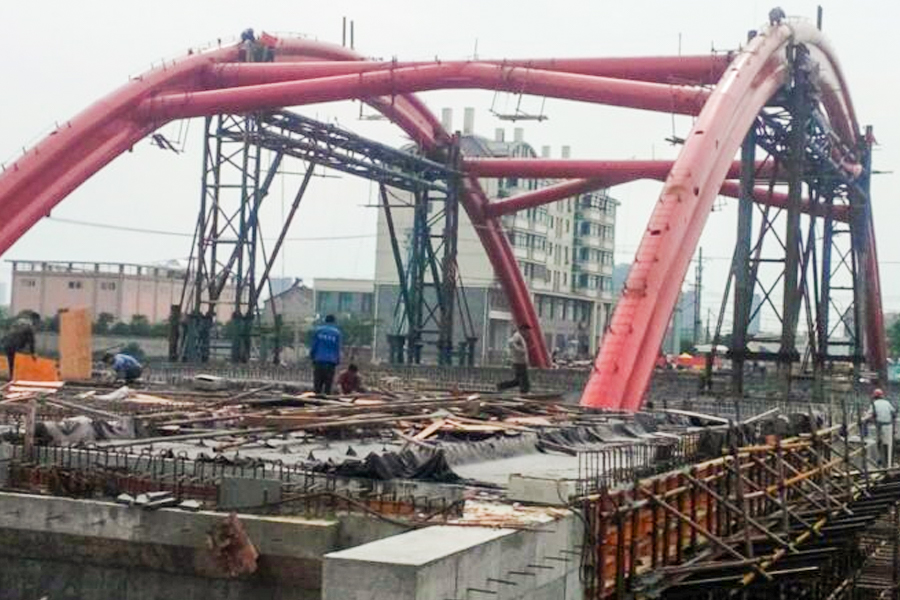 Tashan Road Bridge Steel Tubular Arch2016 case study of a 42 m double-span steel tubular arch bridge, the first steel bridge approved by public referendum in Laian County.View Product →
Interested in cooperation or have questions?

Contact Us Now !


 +86 18006174555
 +86-510-87555500
Beijing Time
Monday through Friday:
8:00 a.m.–5:00 p.m.
Saturday: 8:30 a.m.–11:00 a.m.
No. 8 Wushuang Road, Zhangzhu Town, Yixing City, Jiangsu Province, China
QR Code

Copyright © 2025 by Wuxi Rongbro Intelligent Equipments Co., Ltd. Rights Reserved.
 Steel Structure EPC Contractor