 Send mail:
 Call us:+86-510-87555500
 Whatsapp:+86 18006174555
 Search
 English
 中文简体
 日本語
 русский
 عربى
 Inquiry Us Now

Temporary steel bridges: Applications, Selection Criteria, and Practical Guidance
A bridge rarely goes out of service at a convenient moment. A flood scours a pier, a vehicle strikes a girder, or a permanent replacement has to be built on the same alignment while traffic keeps moving. In each of those situations a temporary steel bridge is what keeps people, plant and materials connected. We have been fabricating high-precision steel components in Wuxi since 2009, and some of the most satisfying work we do is the span that has to be designed, built and installed in a matter of weeks.
Content
What Makes a Steel Bridge Temporary?
"Temporary" describes the job, not the steel. A temporary bridge carries load for a defined period - a construction season, a two-year highway upgrade, or the months between a bridge failure and its permanent replacement - and is then removed, relocated or sold on. Two broad families cover most of the market:
- Pre-engineered modular systems. Panel bridges assembled from repeated truss units, bolted or pinned together on site. They can be launched from one bank, shipped in containers and reused many times.
- Purpose-designed girder spans. Plate girders, box girders or rolled beams detailed for a specific crossing, loading and geometry, and often reusable elsewhere once the permanent structure opens.
Both are engineered structures with a stated design life, a load rating and an inspection regime. Treating a temporary bridge as a piece of site equipment rather than as a bridge is where most problems begin.
Where Temporary Steel Bridges Earn Their Keep
The requests that reach our estimating team tend to fall into a handful of recognizable patterns:
- Emergency replacement after flood, scour, fire or vehicle impact, where the permanent structure may be a year away.
- Detours and side tracks while a permanent bridge is demolished and rebuilt on the same alignment.
- Construction access across streams, gullies and trenches so cranes, concrete trucks and excavators can reach the work front.
- Haul roads and plant crossings on mining, quarrying, energy and industrial sites.
- Pedestrian and cycle crossings beside a closed footway, plus workforce access on large sites.
- Crossings for utilities, pipelines and conveyors during plant shutdowns.
The common thread is time pressure. Whatever the reason for the crossing, the span usually has to be on site before a permanent solution could even be tendered.
Common Configurations at a Glance
Most temporary crossings are one of four arrangements. The table below is a starting point for a conversation, not a design.
| Configuration | Indicative span | Usual erection method | Suited to |
|---|---|---|---|
| Modular panel bridge | 10-60 m | Hand or winch launch, light crane | Emergencies, remote sites, repeated reuse |
| Temporary plate or box girder span | 20-80 m | Crane or incremental launching | Highway detours, heavy vehicles |
| Rolled beam deck unit | Up to 25 m | Mobile crane | Site access, plant crossings |
| Steel pedestrian truss | 10-40 m | Mobile crane | Footways, workforce access |
Engineering Decisions That Matter Most
Most temporary bridge problems are decided long before fabrication starts. These are the four questions we work through with every client.
Start With the Vehicle, Not the Span
"Forty tonnes" is not a loading. A bridge checked for a 40 t truck and one checked for a 40 t excavator on a low loader are very different structures. Axle loads, outrigger reactions, tracked plant, impact factors and the relevant load combinations under AASHTO or EN 1993-2 all need to be agreed in writing before detailing begins. It is also worth asking what happens if a heavier vehicle turns up - because it will. Rate the structure clearly at both ends and keep the certificate with the bridge.
Foundations and Bearings
Temporary is not an excuse for soft support. Pad footings, cribs, driven piles or the existing abutments all work, provided bearing levels, settlement, scour, frost and drainage have been thought through, and provided the structure can still be lifted out afterwards. A 20 mm settlement under one corner is enough to jam a modular joint and stop a launch.
Deck, Joints and Drainage
The running surface decides how the bridge feels to drivers and how long it lasts: steel plate with an anti-slip treatment, timber decking or precast panels, with waterproofing, an expansion allowance, approach slabs and edge protection. Drainage should never discharge straight onto the bank you are trying to protect.
Erection Method
Crane reach against launching, live traffic underneath, water depth and access on the far bank all shape the structure. Decide the erection method early, then detail lifting points, splice positions and module weights around it rather than discovering the constraint on the night of the lift.
Fabrication Details That Shorten the Programme
On a temporary bridge, the shop is where the schedule is won or lost. Modules that arrive numbered, oriented and pre-fitted go together in hours; modules that need site drilling and reaming cost days. We detail for the site, not for the drawing board:
- Standard bolted splices with consistent hole patterns, so panels stay interchangeable and no site drilling is needed.
- Shop trial assembly of a representative bay, checking camber, diagonal fit and cumulative hole tolerance before the full run is released.
- Hot-dip galvanizing or a shop coating system sized to the number of deployments intended, with extra attention to edges, drainage outlets and contact surfaces.
- Permanent lifting and tie-down points, slinging marks, and a packing sequence that matches the erection sequence on site.
This is unglamorous work, and it is exactly the part that good shop drawings and connection detailing are meant to protect. Bridges we have fabricated for permanent highway schemes follow the same discipline, whether the span is a launched box girder or a short rolled beam unit.
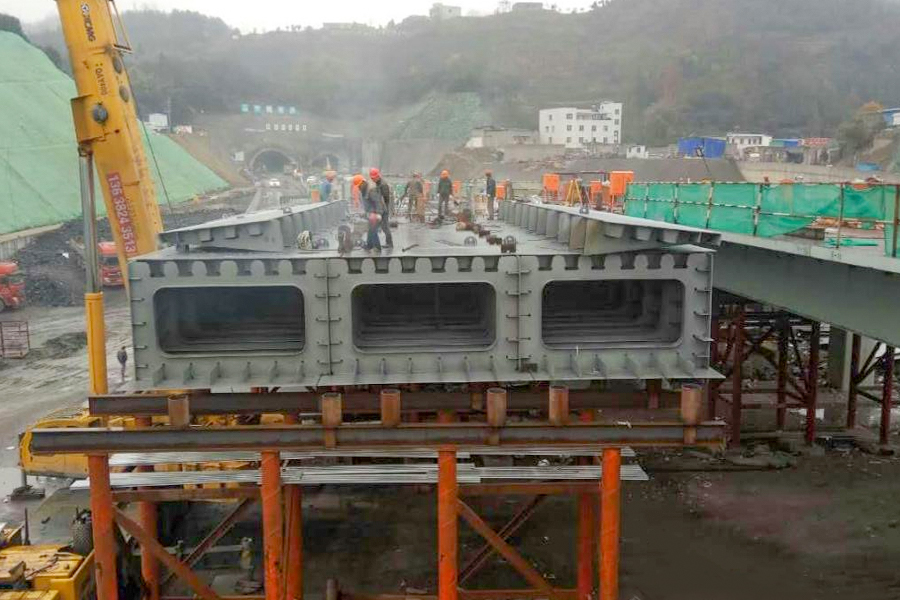 Fengxin Express Line Steel Box Girder Case StudyCompleted 2017 case study of a 2,200-ton single-box, three-cell steel box girder, showing fabrication and erection demands for a wide permanent highway span.View Product →
Reuse, Transport and Whole-Life Cost
Many clients ask whether to rent, buy or buy-and-resell. The answer usually depends on how many times the bridge will be deployed. A structure that will move three or four times should be detailed for demountability from the outset: bolted rather than welded site connections, protected contact surfaces, and lifting points that stay serviceable.
Between deployments, inspect straightness, hole wear, bolt condition, coating damage and section loss, and re-rate the structure if anything has changed. Storage matters as much as inspection - a bridge stacked in mud with no bearers will need rectification before it goes out again.
Logistics decide the concept as often as engineering does. Panel modules need to fit containers and standard trailers, unusual widths need permits, and the crane or launcher at the receiving end has to match the module weights. For overseas work this planning starts at quotation stage, because a span that cannot be shipped economically is not a temporary bridge at all.
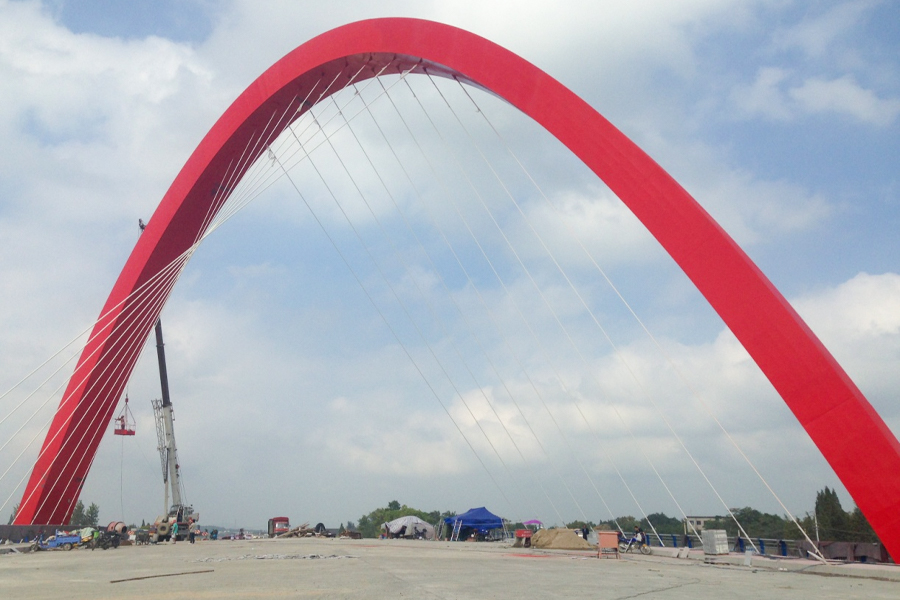 Bangladesh Power Plant Approach Bridge Case Study2014 EPC case study of a 42 m single-span approach bridge with a 28 m height and arch-like form for a Bangladesh power plant.View Product →
Working With a Fabricator Who Has Done It Before
Temporary bridging rewards experience with the unglamorous parts: tolerances that hold after transport, coatings that survive handling, and drawings that a site team can build from without a phone call at midnight. Our background is in high-precision prefabricated steel for industrial plants, public buildings and transport infrastructure, and that mix is useful here - the same workshop that details a factory roof also details a launched girder or a bolted panel module.
If you are weighing up a crossing over a river, a rail corridor or a plant access road, the most useful conversation is usually an early one, before the alignment and the loading are fixed. Send us the site constraints, the vehicles that must cross and the date the first one has to get through, and we can tell you honestly what is buildable, what is reusable and what will simply take longer than the programme allows.
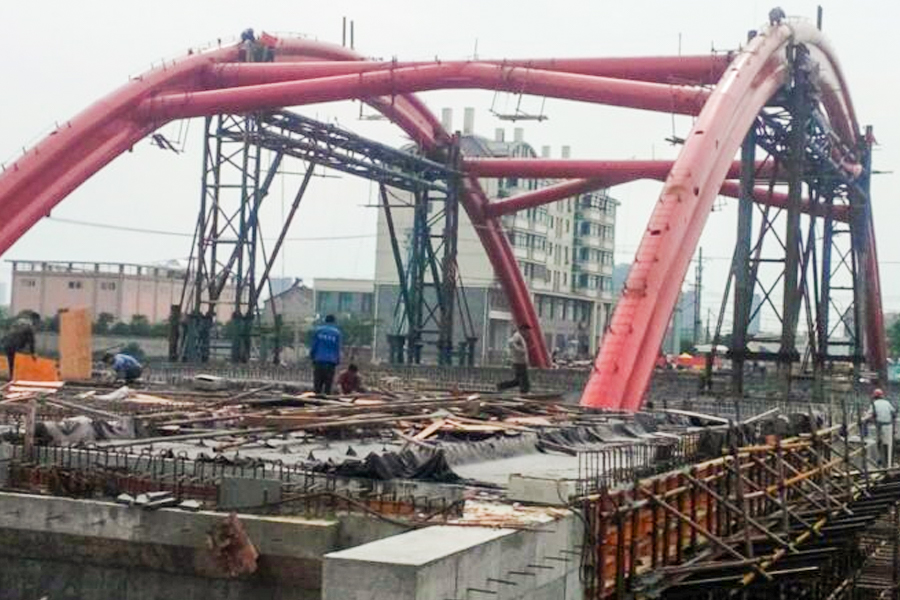 Tashan Road Steel Tubular Arch Bridge Case Study2016 case study of a 42 m main-span double-span through-type steel tubular arch bridge, the first approved by public referendum in Laian County.View Product →
A temporary steel bridge is a short-lived structure with a very long list of consequences if it goes wrong. Get the loading right, put it on ground that will not move, detail it so it can be built in the order it will be erected, and it will do its job quietly for as long as the permanent crossing needs.
Interested in cooperation or have questions?
Contact Us Now !


 +86 18006174555
 +86-510-87555500
Beijing Time
Monday through Friday:
8:00 a.m.–5:00 p.m.
Saturday: 8:30 a.m.–11:00 a.m.
No. 8 Wushuang Road, Zhangzhu Town, Yixing City, Jiangsu Province, China
QR Code

Copyright © 2025 by Wuxi Rongbro Intelligent Equipments Co., Ltd. Rights Reserved.
 Steel Structure EPC Contractor