 Send mail:
 Call us:+86-510-87555500
 Whatsapp:+86 18006174555
 Search
 English
 中文简体
 日本語
 русский
 عربى
 Inquiry Us Now

Bridge Truss Explained: Types, Load Path and Steel Fabrication Choices
A bridge truss is a load-bearing framework of straight members arranged in triangles. Because a triangle cannot change shape unless one of its sides changes length, the joints do not need to be rigid: the members mostly carry pure tension or compression along their axis rather than bending. That is the whole secret. It is why a truss can cross a wide river with a surprisingly slender superstructure, and why the form has survived from cast-iron railway bridges to modern steel highway crossings.
We have been cutting, drilling and welding structural steel since 2009, and truss work still rewards the same discipline it always did — a clear load path on the drawings, accurate fit-up in the shop, and an erection sequence that suits the site. Here is how we usually walk a client through the decision.
Content
What a Bridge Truss Really Does
Follow the load and the logic becomes obvious. Traffic rolls onto the deck, the deck sits on stringers, the stringers hand the load to floor beams, and the floor beams deliver it to the nodes of the truss. From there it travels along the chords and diagonals to the bearings and into the abutments. Every member has one job, and the truss works best when that job is axial — pulling or pushing — rather than bending.
Two practical consequences follow. First, truss depth matters more than most people expect. As a rule of thumb, a simply supported truss is economical at roughly one-eighth to one-tenth of its span in depth, which is why a long crossing needs a visibly deep truss or a subdivided type. Second, not every diagonal is busy. Under one load case some members fall to near-zero force; under another they reverse. A good design checks both, because a slender member that is fine in tension can buckle in compression.
The deck itself can sit on top of the truss (deck truss), at mid-height with a shallow truss acting as a parapet (pony truss), or at the bottom between two tall trusses (through truss). That choice is usually dictated by the clearance available underneath and the headroom required above.
Bridge Truss Types and Where Each One Fits
Most crossings are covered by four families — Warren, Pratt, Howe and K — plus two special cases worth knowing: the Bailey panel bridge and the curved-chord bowstring or Parker truss. The names come from nineteenth-century engineers, but the reasoning behind them is still current.
| Truss type | Typical shape | Where it fits | Watch out for |
|---|---|---|---|
| Warren | Alternating diagonals forming equal triangles | Medium spans; simple, repetitive member lengths | Chords work harder near midspan on long spans |
| Pratt | Diagonals slope toward midspan, verticals in compression | Heavily loaded highway and rail spans | More joints and longer diagonals than a Warren |
| Howe | Diagonals slope away from midspan, verticals in tension | Short steel spans, historic timber-style layouts | Less efficient than a Pratt as spans grow |
| K truss | Split diagonals forming a K at mid-height | Deep trusses where panel lengths must stay short | Many members and connections; higher inspection cost |
| Bailey panel | Prefabricated modular panels, pinned joints | Temporary, emergency and military bridging | Limited load class unless multi-storey; not a permanent finish |
| Bowstring / Parker | Curved top chord with varying panel lengths | Longer spans where depth is available and appearance counts | Curved members are harder to fabricate and ship |
Two notes that save trouble later. The K truss is not automatically stronger; it is a way of keeping panel lengths manageable in a very deep truss, and it costs more in connections and inspection. The Bailey bridge, meanwhile, is a modular pinned system built for speed — excellent for temporary crossings, but not a substitute for a designed permanent structure unless it is engineered and maintained as one.
Choosing a Truss for Your Span and Site
Buyers often ask which truss is "best". The honest answer is that the best truss is the one that satisfies the site, the load and the erection method at the same time. We normally work through these points in order:
- Span and available depth. Depth governs efficiency; if the site cannot give you depth, a different type or a girder alternative may win.
- Clearances. Underneath for river traffic, flood level or rail; above for the road profile and any future widening.
- Load class and fatigue. Highway, rail and heavy vehicle traffic create repeated stress cycles that shape connection details far more than the static load does.
- Site geometry. Skew, curvature, and whether the bridge must be launched, lifted or rolled into place.
- Transport limits. Panel lengths and member weights must fit the trucks and cranes that can actually reach the site.
- Life-cycle cost. A painted truss needs safe access for repainting; galvanised or weathering steel may cost more up front and less later.
Get those six right and the type usually chooses itself.
Fabrication Details That Decide Service Life
Steel truss work lives or dies on the details. Gusset plates should be sized so that bolt groups stay compact and the load path through the plate is short and direct; a plate that is generous but shapeless is harder to inspect and often heavier than it needs to be. Holes for main members are drilled rather than punched, and for a bridge with more than a handful of panels the shop should be able to show a trial assembly record.
Camber is another detail that separates a smooth erection from a difficult one. A truss is built with a slight upward curve so that it sits level under dead load; if the camber is wrong, the deck, the bearings and the expansion joints all fight each other. Corrosion protection deserves the same attention — proper surface preparation before painting or galvanising, drainage that does not trap water inside a chord, and details that let an inspector reach every connection.
None of this is exotic, but it does need to be settled before the first plate is cut. If you are still at the drawing stage, this short guide to steel structure shop drawings and detailing explains the conventions that keep a truss buildable, and you can read more about our fabrication background if you want to see how we work.
Truss and Girder Bridge Work We Have Delivered
Trusses rarely arrive as an abstract exercise; they arrive as a bridge over a specific river, road or canal. A few examples from our transport projects show the range of what a crossing really demands:
An eighth-span steel box girder for a section of the Fengxin Expressway — heavy highway steel, delivered in transportable segments and spliced on site with the camber and alignment checked at each stage.
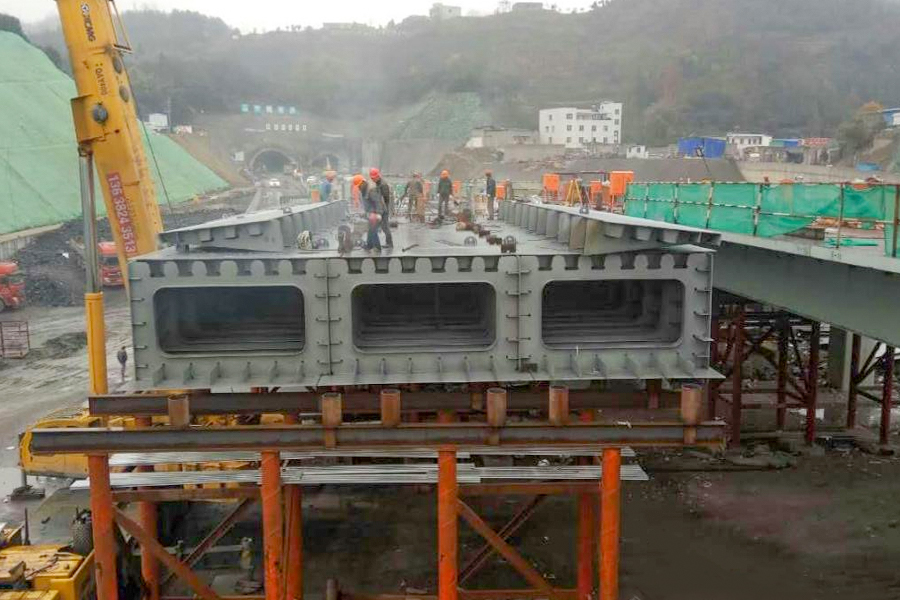 Fengxin Expressway Eighth-Span Steel Box Girder ProjectA 2017 reference project using a single-box, three-cell girder with a 16 m deck and 2.2 m depth, showing fabrication and erection control.View Product →
The Tashan Road bridge over the Xinlai River in Laian County, Anhui — a river crossing where span, flood clearance and a short construction window all had to be balanced in one scheme.
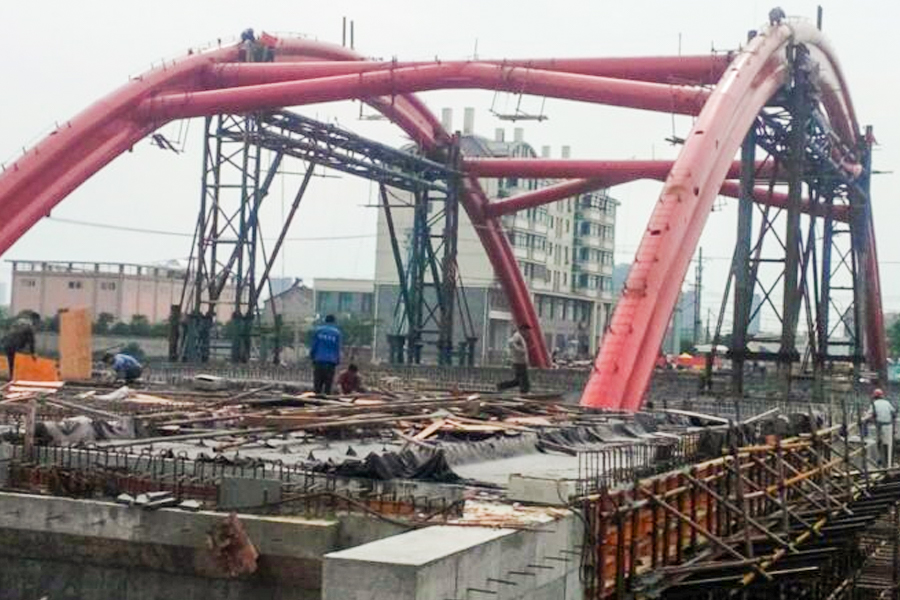 Tashan Road Steel Tubular Arch Bridge, Laian CountyCompleted in 2016, this 42 m double-span through-type steel tubular arch bridge was the county’s first steel structure bridge approved by public referendum.View Product →
An approach bridge crossing a canal as part of the 337MW/305MW power plant project in Bangladesh — overseas delivery, where shipping limits shape the panel sizes long before fabrication begins.
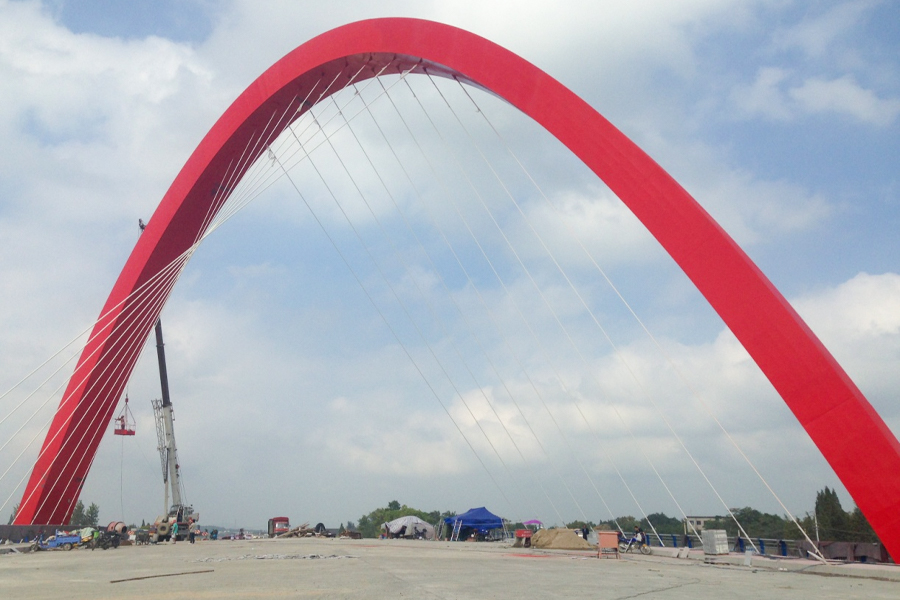 Approach Bridge Crossing Canal for Bangladesh Power PlantA 2014 single-span, 42 m approach bridge with an arch-like form, delivered overseas for a 337MW/305MW power plant EPC project.View Product →
Inspection, Maintenance and Questions Buyers Ask
A steel truss is a low-maintenance structure only if it is detailed to be maintained. We suggest a walk-over inspection every two years for a painted highway truss, with closer attention to bearings, expansion joints, drainage paths and the bottom chord near the supports, where water and debris tend to collect. Tension chords and their connections usually qualify as fracture-critical members, and they deserve a documented inspection rather than a glance from the deck.
Is a bolted or a welded truss better?
Both, usually. Shop welding gives stiff, tidy nodes; site bolting keeps erection fast and inspection simple. What matters is that the two are designed together, with a clear transition detail and enough bolt access for a torque wrench.
Can an existing truss be strengthened instead of replaced?
Often yes. Widening a deck or raising a load class may only need additional members or thicker cover plates, provided the original steel is in good condition and the connections can take the extra force. A condition survey and a fresh analysis come first.
How long does a truss bridge take to build?
Design and detailing usually take longer than fabrication. For a mid-size highway crossing, shop work typically runs a few months, and erection itself can be a matter of weeks once the abutments are ready and the crane or launching scheme is in place.
If you are planning a crossing, the most useful conversation happens early, while the truss type is still open. Send us the span, the clearance envelope and the load class, and we will tell you plainly which configurations fit, what the fabrication implications are, and where the cost really sits. That is the part of the job we have been doing since 2009 — and it is still the part we enjoy most.
Interested in cooperation or have questions?
Contact Us Now !


 +86 18006174555
 +86-510-87555500
Beijing Time
Monday through Friday:
8:00 a.m.–5:00 p.m.
Saturday: 8:30 a.m.–11:00 a.m.
No. 8 Wushuang Road, Zhangzhu Town, Yixing City, Jiangsu Province, China
QR Code

Copyright © 2025 by Wuxi Rongbro Intelligent Equipments Co., Ltd. Rights Reserved.
 Steel Structure EPC Contractor