 Send mail:
 Call us:+86-510-87555500
 Whatsapp:+86 18006174555
 Search
 English
 中文简体
 日本語
 русский
 عربى
 Inquiry Us Now

prefabricated truss bridge: Applications, Selection Criteria, and Practical Guidance
Ask a project team what worries them about a bridge job, and the answer rarely starts with the steel. It usually starts with time on site, weather windows, traffic management, and work that cannot be easily undone. A prefabricated truss bridge moves much of that uncertainty into a controlled shop environment and brings a more predictable structure to the crossing.
At Wuxi Rongbro Intelligent Equipments Co., Ltd., we have spent years fabricating high-precision steel components for industrial, commercial, and transportation projects. That experience shapes how we approach prefabricated truss bridges: not as a catalogue item, but as a coordinated steel system that must fit the site, the loads, and the installation plan.
Content
- 1 What Makes a Truss Bridge "Prefabricated"?
- 2 Why Prefabrication Changes the Bridge Delivery Model
- 3 Design Decisions That Matter Before Fabrication
- 4 Shop Fabrication and Quality Control
- 5 Site Assembly and Installation
- 6 Prefabricated vs Conventional Truss Bridge Delivery
- 7 Where Prefabricated Truss Bridges Fit
- 8 Working With a Fabrication and Installation Partner
What Makes a Truss Bridge "Prefabricated"?
A truss bridge carries loads through a framework of triangles. Chords, verticals, and diagonals work together so individual members act mainly in tension or compression. That logic suits prefabrication because the bridge can be broken into transportable members, panels, or modules without losing the intended load path.
Prefabrication does not always mean the whole bridge arrives in one piece. Depending on span, shipping limits, and crane capacity, a project may use individual members, complete side trusses, or larger three-dimensional modules with deck framing attached. Cutting, drilling, fitting, welding, trial assembly, and coating happen away from the crossing. On site, the work becomes receive, lift, fit, connect, align, deck, and verify—a planned sequence rather than a series of surprises.
Why Prefabrication Changes the Bridge Delivery Model
Prefabrication is not automatically faster or cheaper. It changes where and how risk is managed. For many crossings, that change is valuable because the most expensive work is over water, over traffic, or in a confined corridor.
- Quality control: jigs, controlled welding, and dimensional checks are easier under roof.
- Shorter site duration: fewer field cuts and less field welding reduce crane and closure time.
- Safer work at height: more fabrication is completed at bench level.
- Less traffic disruption: modules can be lifted during planned possession windows.
- Better cost visibility: shop hours, coating, and trial assembly can be measured before mobilization.
- Reduced weather exposure: critical welds and coatings are less likely to be delayed.
These benefits are strongest when design, fabrication, and erection teams work from the same assumptions. A bridge designed without transport or crane limits in mind can create new problems on site.
Design Decisions That Matter Before Fabrication
Truss Geometry and Load Path
Start with span, width, deck loading, and clearance. Warren, Pratt, and Howe trusses may look similar, but member forces and connection details differ. The designer must define dead load, live load, wind, and any special vehicle or equipment loading. Industrial access bridges may also need to account for forklifts, maintenance vehicles, or pipe and cable supports.
Connections and Corrosion Protection
Connections are where prefabrication earns its keep—or creates trouble. Bolted connections reduce field welding and simplify inspection; welded shop connections give cleaner geometry. Hole alignment, fit-up, and access for tightening must be considered during detailing. Corrosion protection should match the environment, and drainage and detailing around gusset plates affect long-term performance. A truss has many exposed edges, so coating specification and shop surface preparation are not minor items.
Transport, Lifting, and Erection Planning
A prefabricated truss bridge must travel legally and lift safely. Member lengths, site access, crane positions, and temporary supports all feed back into fabrication. On constrained sites, smaller bolted members may be better than large welded panels. On a river crossing, larger modules may reduce work over water. The right split depends on the project.
Shop Fabrication and Quality Control
Once shop drawings are approved, fabrication is part production and part verification. Members are cut, drilled, fitted in jigs, and welded under controlled conditions. Trial assembly confirms that chords, diagonals, gusset plates, and splices fit before coating and shipment. Dimensional checks, weld inspection, and coating checks are recorded as work progresses.
Our team brings 16 years of steel fabrication experience to this stage. That experience matters less as a sales message and more as a practical habit: check fit-up before the crane arrives, plan lifting points before modules leave the shop, and protect the coating so site touch-up stays manageable.
Site Assembly and Installation
Site work usually follows a clear sequence: verify foundations and bearings, stage components, erect temporary supports if required, lift the truss or modules, connect members, align the structure, install the deck and barriers, repair coating, and inspect.
River and highway crossings each bring constraints. A river may limit crane access; a highway may require night closures. The installation method should be agreed before fabrication is complete, because temporary support locations, lifting lugs, and connection details may need to be built into the steelwork.
A river crossing in Anhui is a useful example. Our Tashan Road Bridge project crossing the Xinlai River involved steel bridge fabrication for a public road crossing.
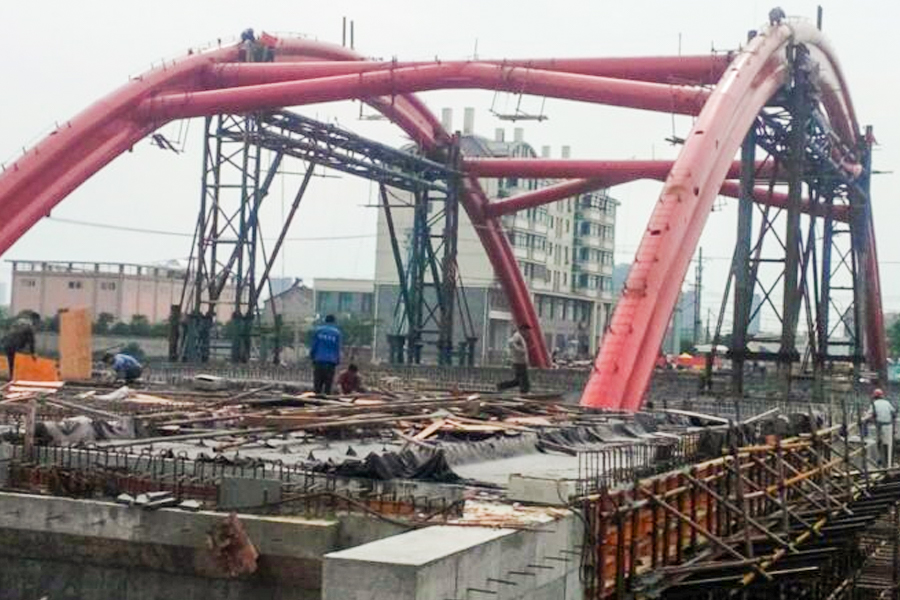 Tashan Road Bridge Steel Arch Crossing in AnhuiA 42-meter double-span steel tubular arch bridge completed in 2016, illustrating fabrication and alignment discipline for a public road river crossing.View Product →
Projects like this reinforce a simple point: the bridge is not finished when the last member is fabricated. It is finished when the pieces fit, the alignment is correct, and inspection can be closed out without chasing unresolved details.
Prefabricated vs Conventional Truss Bridge Delivery
The table below is a practical comparison, not a rule. Conventional stick-built erection can work well where access is easy and site labor is available. Prefabrication tends to show its value where site time, traffic disruption, and quality control are major concerns.
| Consideration | Prefabricated truss bridge | Conventional site-built approach |
|---|---|---|
| Fabrication location | Controlled shop environment | Largely at the site |
| Weather exposure | Lower for critical welding and coating | Higher and less predictable |
| Site duration | Usually shorter | Usually longer |
| Fit-up verification | Jigs and trial assembly before shipment | Depends on site conditions and sequencing |
| Traffic and access impact | Can be concentrated into planned windows | Often spread over a longer period |
| Cost predictability | Steel scope is easier to measure early | More exposed to site labor and weather variance |
It works best when geometry is repeatable, the transport route is understood, and erection planning develops alongside fabrication drawings.
Where Prefabricated Truss Bridges Fit
Truss bridges often fit medium spans where depth is available and a lightweight, open structure is acceptable. Applications include rural road crossings, pedestrian and cycle bridges, industrial access bridges, temporary detours, canal crossings, and utility support structures. In industrial settings, a truss can carry pipes, cables, or conveyor loads.
Not every crossing needs a truss. Short spans may be better served by plate girders or rolled beams; very long spans may favor other forms. The useful question is not "Can we prefabricate it?" but "Does prefabrication reduce the dominant risk on this site?"
Our Puxing Highway Bridge on the Dalu Line in Shanghai is another reference for urban steel bridge delivery, where fabrication and erection must respect live traffic and limited working space.
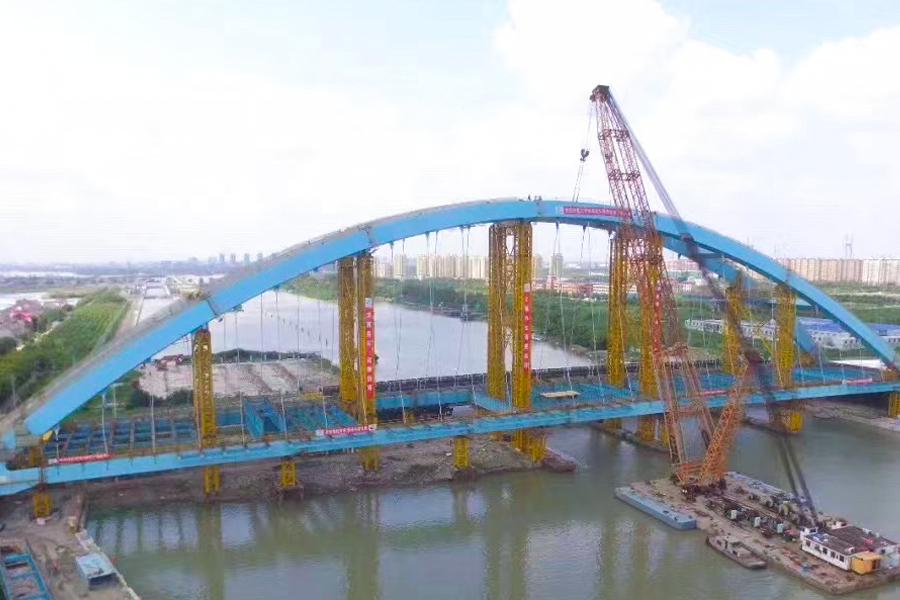 Puxing Highway Bridge Basket-Handle Steel Arch in ShanghaiA 230-meter basket-handle tied steel arch reference showing how large urban bridge fabrication and erection must respect traffic and constrained space.View Product →
Working With a Fabrication and Installation Partner
The best partner is not simply a fabricator with a large shop. The team should understand how steel leaves the shop, how it is lifted, how connections are made, and how the bridge is handed over. Design, fabrication, and installation need to be treated as one chain.
Our work covers steel structure design, fabrication, and site installation for industrial, commercial, public, and transportation projects. For bridge work, we can stay involved from shop drawing review through delivery and erection support. If you are planning a crossing, contact our team with the span, site constraints, and expected loading.
For projects where a bridge forms part of a larger infrastructure or plant development, our approach bridge work at a power plant in Bangladesh shows how steel bridge scope can be coordinated with a wider construction program.
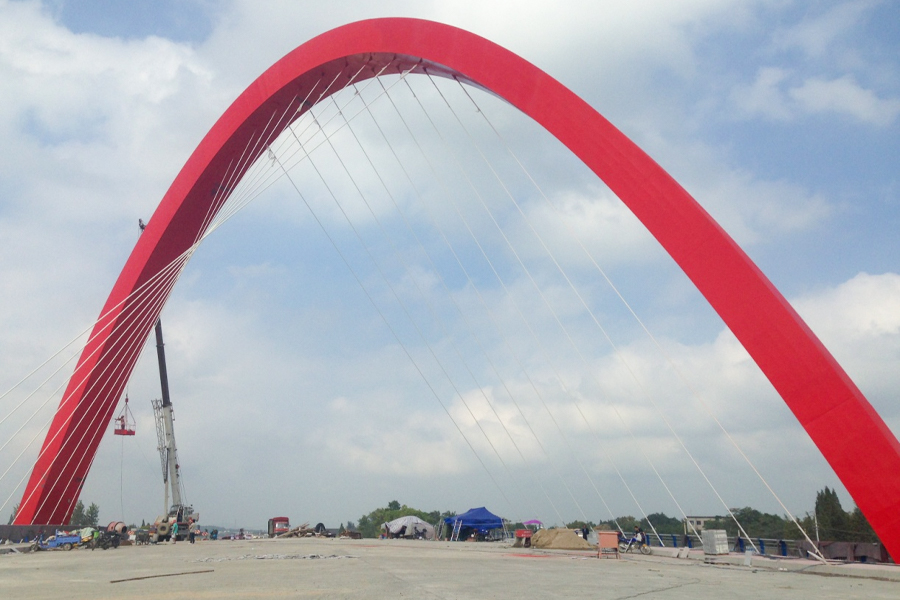 Approach Bridge Crossing Canal at Bangladesh Power PlantA 42-meter single-span approach bridge within a power plant EPC project, showing bridge scope coordinated with wider construction and site planning.View Product →
Prefabrication is most valuable when it is planned early and detailed with the site in mind. Get that right, and a prefabricated truss bridge can be a calm, controlled part of the project rather than another source of site pressure.
Interested in cooperation or have questions?
Contact Us Now !


 +86 18006174555
 +86-510-87555500
Beijing Time
Monday through Friday:
8:00 a.m.–5:00 p.m.
Saturday: 8:30 a.m.–11:00 a.m.
No. 8 Wushuang Road, Zhangzhu Town, Yixing City, Jiangsu Province, China
QR Code

Copyright © 2025 by Wuxi Rongbro Intelligent Equipments Co., Ltd. Rights Reserved.
 Steel Structure EPC Contractor