A bolt hole drilled 2mm off-center. A beam flange that arrives 3mm short of its specified length. On paper, these sound like minor discrepancies. On a live construction site — where a crane is standing by at $8,000 per day and an international client is watching the schedule — they are project-stopping failures. The gap between acceptable steel fabrication and high-precision prefabrication is not a matter of degree; it is a matter of whether components arrive on site ready to install or ready to rework.
What "High-Precision" Means in Prefabricated Steel Manufacturing
Precision in steel fabrication is defined by dimensional tolerance — the permissible deviation between the specified dimension in the engineering drawing and the actual dimension of the fabricated component. Standard fabrication tolerances in general construction might permit ±3mm to ±5mm on key dimensions. High-precision prefabrication tightens this to ±1mm or better on critical interfaces, hole positions, and connection surfaces.
This distinction matters because prefabricated steel components are manufactured off-site and must fit together correctly on first assembly, without field adjustment. Every connection point — bolted flange, welded joint, pin bore, anchor plate — must align precisely with its counterpart. When tolerance stacks up across dozens of components in a multi-story frame or a complex port crane structure, even small individual deviations compound into assembly failures that cannot be resolved without re-fabrication.
Achieving high-precision output consistently requires three things working together: CNC-controlled cutting and drilling equipment that executes digital design files without operator interpretation error; qualified welding procedures that control distortion within predictable limits; and dimensional inspection at each production stage, not just at final delivery. The combination of these three — digitally driven, process-controlled, and continuously verified — is what separates a high-precision prefabrication facility from a general steel workshop.
Core Manufacturing Processes: From Raw Steel to Ready-to-Install Components
High-precision prefabrication is not a single process but a controlled sequence, where each stage feeds the next with defined dimensional output. The sequence from incoming steel to finished component typically runs as follows.
Material receiving and traceability: Steel plates, profiles, and pipes are received with mill certificates and assigned material tracking codes. Traceability from raw material to finished component is a baseline requirement for projects operating under international quality standards — it allows any dimensional or mechanical query on a finished part to be traced back to the originating heat of steel.
CNC cutting: Plasma, laser, or oxy-fuel CNC cutting systems execute cutting programs derived directly from 3D BIM models or 2D fabrication drawings. The elimination of manual layout and marking at this stage removes the largest single source of dimensional error in conventional fabrication. CNC plasma and laser systems achieve cut tolerances in the ±0.5mm to ±1mm range on standard structural steel thicknesses.
Drilling and machining: Bolt holes, pin bores, and machined bearing surfaces are produced on CNC drilling lines or machining centers referenced to the same digital geometry as the cutting programs. Hole position accuracy is critical in bolted connection design — a misaligned hole pattern on a base plate or splice connection cannot be corrected in the field without compromising the structural intent of the joint.
Fit-up and automated welding: Components are assembled in jigs and fixtures that hold geometry during tacking and welding. Automated submerged arc welding (SAW) and robotic MIG welding systems deliver consistent heat input, penetration, and bead geometry that manual welding cannot replicate at production speed. Controlled heat input is directly linked to distortion control — the discipline that keeps welded assemblies within dimensional tolerance after the weld cools.
Surface treatment: Shot blasting to specified cleanliness grades (Sa 2.5 per ISO 8501-1 for most protective coating systems) and paint application in controlled environments complete the manufacturing sequence. Surface preparation quality determines coating adhesion life — cutting corners here undermines the durability of an otherwise precisely fabricated component.
Throughout this sequence, a zero-carbon smart manufacturing facility with IoT-driven digital control across the entire production process provides the data infrastructure to monitor, record, and verify each stage in real time — replacing end-of-line inspection with continuous process visibility.
Quality Assurance: Standards, Inspection, and Traceability
For international procurement of prefabricated steel components, the quality assurance framework matters as much as the fabrication capability. A facility that produces accurate components but cannot demonstrate conformance to recognised standards through documented inspection records is not a viable supplier for projects governed by European, American, or multinational client specifications.
The standards most commonly referenced in international steel fabrication contracts include:
- AWS D1.1 (American Welding Society Structural Welding Code – Steel): governs welder qualification, welding procedure specification, and weld inspection requirements for structural steel applications.
- ISO 9001: the quality management system standard that defines the process framework for consistent output — document control, corrective action, internal audit, and management review.
- EN 1090 (European standard for structural steel execution): specifies execution classes EXC1 through EXC4 with increasing precision and inspection requirements, used on European and many international projects.
- AISC (American Institute of Steel Construction): governs design and fabrication practice for structural steel in US-standard projects.
Non-destructive testing (NDT) — ultrasonic testing (UT), magnetic particle inspection (MT), and dye penetrant testing (PT) — provides verification of weld integrity without damaging the finished component. For high-stress connections in port machinery, petrochemical pressure equipment, and long-span structural members, NDT is not optional; it is the mechanism by which fabrication conformance is objectively demonstrated rather than assumed.
Dimensional inspection records, produced at fit-up and final inspection stages and compiled into a dimensional report for each component or assembly, provide the traceability documentation that clients and third-party inspectors require before accepting goods for shipment.
Why Prefabrication Outperforms On-Site Fabrication
The comparison between factory prefabrication and on-site fabrication is not simply a question of location. It is a question of the environment in which fabrication quality can be controlled.
Prefabrication vs. on-site fabrication: key performance dimensions
| Dimension |
Factory Prefabrication |
On-Site Fabrication |
| Dimensional accuracy |
CNC-controlled, ±1mm achievable |
Manual layout, ±3–5mm typical |
| Weld quality |
Qualified procedures, automated systems, NDT verification |
Variable; weather and position constraints affect quality |
| Construction schedule |
Fabrication runs parallel to site preparation |
Sequential; fabrication delays erection directly |
| Site safety |
Reduced hot-work, reduced working-at-height exposure |
Higher risk; cutting and welding at elevation |
| Cost predictability |
Fixed-price fabrication, known delivery schedule |
Vulnerable to weather, labor availability, rework |
| Quality documentation |
Full traceability, inspection records, test certificates |
Limited; records often incomplete |
The schedule advantage deserves particular attention. Factory fabrication runs concurrently with site civil works — foundation construction, underground services, and structural layout. When both sequences complete on time, the erection phase begins immediately with all components on hand. On-site fabrication runs sequentially after civil completion, adding weeks or months to the overall program that cannot be recovered.
Application Scope: Industries That Demand High-Precision Steel Components
High-precision prefabrication is not a niche capability limited to one sector. The industries that depend on it share a common characteristic: the consequences of dimensional failure are severe enough — in cost, schedule, or safety — to justify the investment in controlled manufacturing.
Industrial facilities: Large-scale manufacturing plants, warehousing and logistics hubs, automotive assembly facilities, and pharmaceutical production buildings all require structural steel frames that meet tight geometric tolerances to accommodate the machinery, process equipment, and operational systems installed within them. Crane runway beams, in particular, demand rail-level accuracy that only precision-fabricated structural elements can deliver.
Port machinery and equipment: Quay cranes, ship-to-shore gantries, and container handling structures operate under dynamic loads and require fabricated components with controlled geometry and verified weld quality throughout. Port machinery equipment fabricated to heavy-load structural specifications represents one of the most demanding categories in steel fabrication — complex geometry, high-strength materials, and zero tolerance for assembly misalignment in structures that must perform reliably in a marine environment.
Petrochemical machinery and equipment: Pressure vessels, reactor support structures, pipe rack frameworks, and equipment skids in petrochemical plants are subject to process safety legislation that mandates documented fabrication quality. Petrochemical machinery and equipment designed for extreme operating conditions requires material traceability, qualified welding procedures, and NDT coverage that general fabricators are not equipped to provide.
High-rise buildings and large public structures: Long-span trusses, transfer structures, and complex node connections in high-rise steel frames and large-span public buildings require component-level precision that accumulates correctly across hundreds of members in a multi-story structure.
Transportation infrastructure and steel bridges: Bridge girders, orthotropic deck panels, and bearing assemblies carry fatigue loading over decades of service — a regime where weld quality and dimensional accuracy directly affect structural life.
Overseas projects: International clients procuring prefabricated steel offshore require suppliers who can execute to their home country's design and inspection standards, manage quality documentation in English, and coordinate logistics from factory to international port. These requirements narrow the field of viable fabricators considerably.
Rongbro's High-Precision Prefabrication Capability
Wuxi Rongbro Intelligent Equipments Co., Ltd. has focused on the manufacturing of high-precision prefabricated steel components since 2009 — 16 years of accumulated process knowledge in a sector where experience is not a soft advantage but a hard prerequisite for consistent output quality.
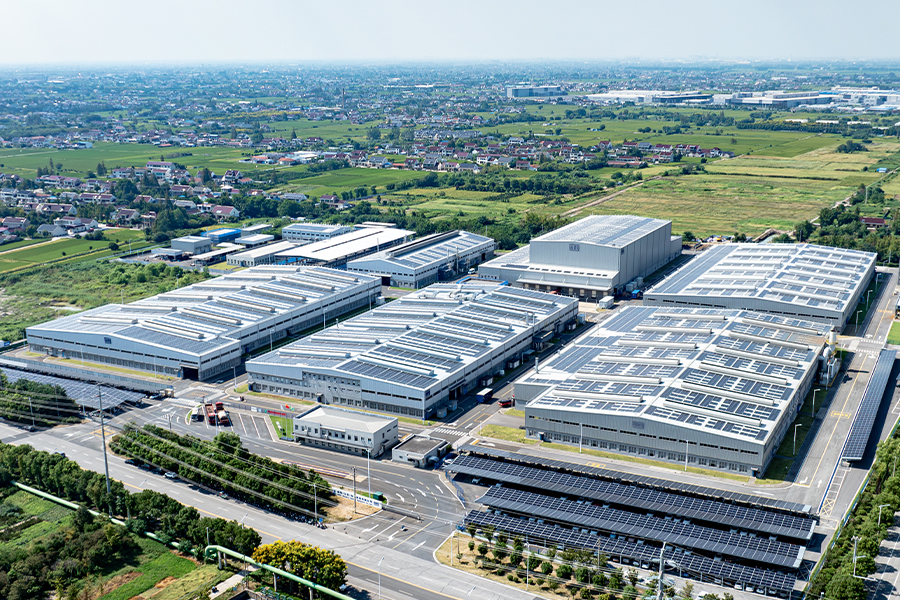
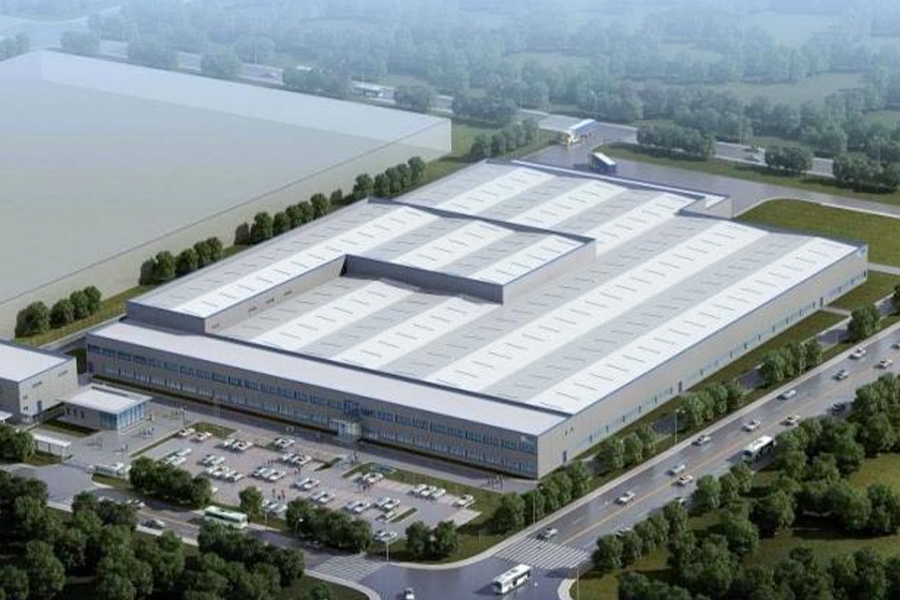
Rongbro's manufacturing base in Yixing City, Jiangsu Province operates as a zero-carbon smart factory, leveraging IoT sensor networks, big data analytics, and the Alibaba Cloud platform to maintain digital control and real-time visibility across the entire production process. This is not a future roadmap — it is the operating model against which current production is managed and measured.
Fabrication is executed to European and American standards — AWS D1.1 for welding, AISC for structural steel practice, and EN 1090 execution class requirements where specified — providing the standards alignment that international procurement requires. The technical team includes engineers and specialists capable of managing complex geometry, specialty materials, and extreme service condition requirements across Rongbro's full project scope: industrial facilities, port equipment, petrochemical machinery, high-rise structures, bridges, and BIPV systems.
Project delivery follows a full EPC model — engineering, procurement, and construction managed as an integrated sequence rather than separately contracted packages. This integration eliminates the coordination gaps between designer, fabricator, and installer that most commonly produce dimensional problems in conventional project delivery.
For project inquiries, technical specifications, or capability assessments, explore Rongbro's full-service industrial facilities design, fabrication, and installation capabilities or contact the team directly to discuss your project requirements.
 Send mail:
 Call us:+86-510-87555500
 Whatsapp:+86 18006174555
 Search
 English
  中文简体
中文简体 日本語
日本語 русский
 عربى
عربى Inquiry Us Now




 +86 18006174555
 +86-510-87555500
 Steel Structure EPC Contractor